
BLOG POST. Only published here.
A brief review of teachings on hemp (Cannabis L.) in Barcelona’s pharmacy curriculum (1835–1939) using archival sources. Phases of presence and neglect are identified, with disciplinary asymmetries between botany & pharmacognosy versus organic chemistry or operations. French-Belgian and German influences stand out, alongside adaptation to changing legal, market, and epistemic contexts.
«Yerba por excelencia» — Presencia & ausencias del cáñamo (Cannabis L.) en los currículums farmacéuticos de la Universidad de Barcelona (1835-1939) — Una revisión breve de las enseñanzas sobre cáñamo (Cannabis L.) a partir de fuentes archivísticas en el currículo de farmacia, Barcelona, 1835–1939. Se identifican fases de presencia/olvido con asimetrías disciplinares entre botánica y farmacognosia vs. química orgánica y prácticas. Destacan influencias franco-belgas, posteriormente alemanas y la adaptación a cambios legales, mercantiles y epistémicos.
3.1. Faculty of Medicine: «Achiche.— […] no es distinto del Cannabis sativa de nuestro país»
3.2. San Victoriano College and early years of the Faculty of Pharmacy (1835–1857)
3.2.1. Lecturers in Transition — From Apothecaries to Pharmacists, from the RCSV to the UB
3.3. Faculty of Pharmacy, University of Barcelona (1857–1939)
3.3.1. Disciplines of Engagement — Botany, Pharmacognosy (Dγ) and Practices (Dδ)
3.3.2. Disciplines of Omission — Organic Chemistry (Dα) and Galenical Pharmacy (Dβ)
3.4. Imported Knowledge: Textbooks & Manuals
1. Introduction
Cultivated in Barcelona’s region for centuries,[1] hemp (Cannabis L.) occupies a particular position within the rich history of pharmacy in an Iberian coast for centuries located at the crossroads of Baghdad and Montpellier. The industrialization of Catalonia between 1832 and 1939, as in the rest of Spain, followed an atypical pattern; within it, an even-more idiosyncratic pharmaceutical sector developed (largely around Barcelona) amidst the intense epistemic frictions of a transition from centuries of apothecary knowledge and trade, onto a reformed scientific paradigm and revolutionised business methods.[2]
Historical analysis of academic curricula in pharmacy-related disciplines can inform on the way knowledge (about ancient but botanically- and chemically-complex medicinal substances like hemp seed and resin) was constructed, reformulated in light of new learnings or influences, and transmitted intergenerationally through academic teachings. In 19th and early 20th centuries Barcelona, Cannabis and its galenical preparations appeared routinely in University programmes, lecture notes, textbooks, and other scholar accounts; yet, approaches varied considerably across disciplines, periods, and professors. Understanding this heterogeneity provides insights into the scientific and pedagogical paradigms shaping Cannabis-related education during a formative era.
By reviewing the disparately-surviving archives, this study attempts to reconstruct pharmacy instruction pertaining to medicinal hemp at the University of Barcelona’s (UB) Faculty of Pharmacy (FP) and associated instruction between 1835 and 1939. The analysis identifies continuities and ruptures in academic discourse, patterns of engagement or omission, and their relationship to evolving pharmacological frameworks, highlighting professors who advanced and shared Spanish and Catalan pharmaceutical knowledge of Cannabis, revealing a unique trajectory in the development of «medical marijuana» in comparison with other countries, also distinct in Universities than in the rest of society. These findings inform contemporary debates on the reintegration of Cannabis within health systems.
2. Archives and limitations
Sources were consulted (2022–2024) in the archival fonds listed in Table 1, as well as in private and online collections. Documentary sources identified therein and related to Cannabis in Barcelona’s Pharmacy curriculum (1830–1962) are listed in Table 2.
Table 1: Archival repositories and collections consulted (click to view)
Table 2: Primary sources consulted (click to view)
All translations are mine. APIs are referred to with their international nonproprietary name (INN). The synonymous terms «hemp» and «Cannabis» are used interchangeably. The main limitation of this study was the disparity of surviving documents (many burnt in 1939)[3] only partly bridged by historiographers.[4] Accordingly, documentary silence is interpreted cautiously and does not necessarily imply an absence of teaching or practice.
3. Teaching [of] hemp
In Spain, the academic curriculum evolved constantly until a stable and lasting «Study plan for enrollment in the Faculty of Pharmacy» in 1886.[5] Despite these formal changes, and countless changes in naming, there was a continuity in teachings. Consequently, the different disciplines are given a name and code to use in this study. For the disciplines taught that are of relevance to Cannabis, and where the plant could have been discussed, the teachings pertained to four scientific disciplines, classified as follows:
- Dα. Organic chemistry applied to pharmacy («Quimica orgánica aplicada a la farmacia»);
- Dβ. Galenical pharmacy: «Prácticas de operaciones farmacéuticas» later renamed «Farmacia Práctica o Galénica», largely practices of the more-theoretical Dα classes (this discipline also generally covered aspects of pharmaceutical legislation and history);
- Dγ. Botany & Pharmacognosy («historia natural» then «materia farmacéutica vegetal»);
- Dδ. Practical exercises: determination of medicinal plants and drug recognition («Ejercicios prácticos: determinación de plantas medicinales y reconocimiento de drogas»), complementing Dγ, taught by assistants or intermediary professors until 1886, replaced by:
- Dδ1. Descriptive botany and plant determination (full professors),
- Dδ2. Practices in animal, mineral, and vegetal pharmaceutical materials (assistants).
In Barcelona’s region, where Cannabis has been cultivated, used, and debated for centuries,[6] the archives of University curricula provide rich material for a study of how knowledge on this medicinal plant was shaped and shared in this pivotal period.
Since the early 18th century, Barcelona’s University had been closed, substituted by two sui generis teaching institutions for health-related higher education: the Real Colegio de San Victoriano (RCSV; Saint Victorian’s Royal College) dispensed classes in apothecary knowledge and the preparation of plant, mineral, and animal substances into medicines — the therapeutics and prescription of which were taught at the Real Colegio de Cirurgia de Barcelona (Royal College of Surgery).[7]
The modern UB was re-incorporated in 1843, the FP two years later. The politically turbulent and scientifically convoluted decades which followed the creation of UB’s faculties were also marked by ever-evolving reforms of the nationwide pharmacy curriculum, until the establishment of a stable teaching framework in 1886,[8] two years before Barcelona’s 1888 Universal Exposition which brought together many «young teachers with particular drive, who came to be known as the “Catalan medical ’88 generation”, and they improved both the level and enthusiasm for teaching».[9] The 1886 reforms transformed the pharmacy curriculum from consecutive, year-specific disciplines spread between the Faculty of Science and of Pharmacy, to a more balanced longitudinal distribution across all four years of study,[10] also mainstreaming the professorate’s mobility between Universities across their careers. Originally separated, the FP and the Faculty of Medicine (FM) settled together in 1906 in the newly-built Hospital Clínic.
3.1. Faculty of Medicine: «Achiche.— […] no es distinto del Cannabis sativa de nuestro país»
Although this study focuses on pharmacy teachings, briefly addressing the FM curriculum provides insights on pharmaceutical types prescribed and their indications. Substantially less records of FM curricula could be consulted, compared to FP. In 19th century medical curricula, the discourse relating to Cannabis therapeutics is limited — with fewer, lesser-recurring, and later-introduced mentions of than in pharmacy — but insightful.
In the neighbouring University of València in 1881, lesson nº92 «Cáñamo y Hachisch» by Amalio Gimeno y Cabañas (1852–1936) within the course «El arte de recetar» defined «Cañamo indiano» as synonym with «Canabis [sic] sativa». That same year, two mentions appear in the gynecopathy course of Francisco de Paula Campà y Porta (1838–1892), pioneer of gynaecology (and later Dean of València’s FP) who moved to teach at the UB three years before his death. He recommended hemp extract to treat the symptoms of dysmenorrhea and menorrhagia — two of the most-recurrent indications in Spain.[11] Cannabis remains present subsequently in València, notably in teachings of Vicente Peset y Cervera (1855–1945), whose work later influenced UB professors.
At Barcelona’s FM, the earliest mention that can be clearly-dated appears in the 1882–1883 programme for therapeutics and pharmacology by Narciso Carbó y Aloy [alternatively, «d’Aloi»] (1826–1890) where Cannabis is already classified as «Estupefacientes (encefálicos, ganglionares, soporiferos, hipnóticos)» and addressed under five sub-items:
«Cáñamo indiano (Haschisch, 1840 Europa). — Origen y usos en Oriente. — Canabina (resina amorfa). — Canabena ó aceite esencial (Canabeno é hidruro de canabeno). — Formas farmacológicas. — Usos médicos.»
Notably, student notes likely from Carbó’s classes (Figure 1) can be estimated from the mid-1870s, and may thus constitute an earlier occurrence than Gimeno and Campà’s.
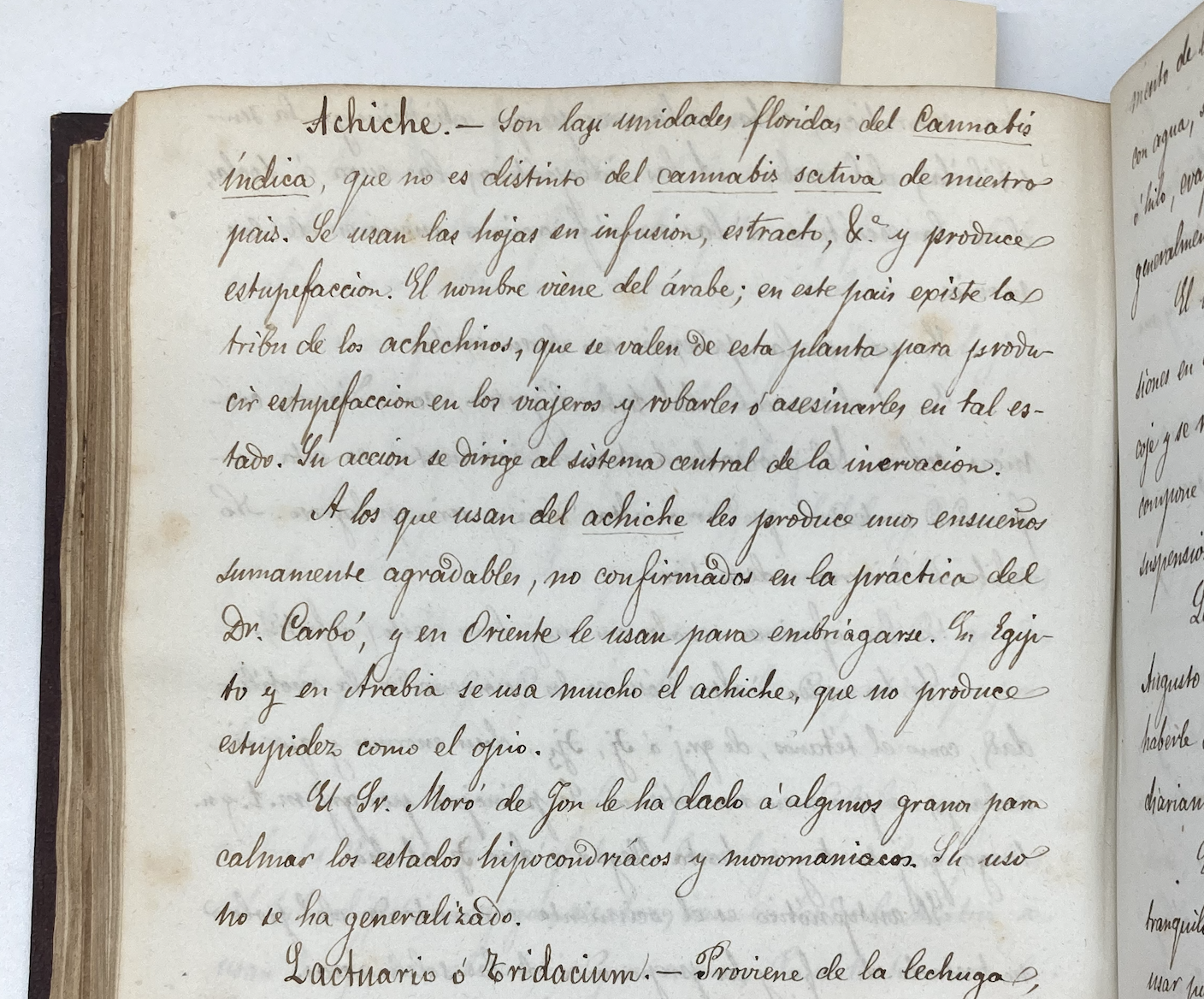
Figure 1. «Achiche» (haschish) in a student’s notes from Carbó’s course on therapeutics. Source: Anon. (c. 1870): f. 16v. (Foto: Arxiu Universitari de la Facultat de Medicina, Universitat de Barcelona).
Other professors left scarce documentation: short address of Cannabis alongside coffee and opium as a means to «turn pain into pleasure» in the 1889 lessons José de Letamendi y Manjarrés (1828–1897); mention in toxicology programmes of Ignacio Valentí y Vivó (1841–1924) in 1894 and 1901. Even fewer records were found in the 20th century, with the exception of Valentín Carulla y Margenat (1864–1923) a key promoter of the Hospital Clínic, lecturer in therapeutics after 1905, and UB’s Rector from 1913. Notes taken by a student (in this case, Manuel Serés, later FM Dean) during his 1908–1909 classes shows a lesson on «cáñamos» (hemps) with narrow therapeutic specifications: «La única verdadera, es su acción sedante para la mucosa del tubo digestivo, […] obra mejor que el opio y todos los demás calmantes.» In available archives, «Indian and indigenous hemp» indeed recur in lessons on «opium substitutes» («succedáneos del Opio») used in sleep, menses, and stomach disorders.
3.2. San Victoriano College and early years of the Faculty of Pharmacy (1835–1857)
Before newer formats, formulas, and terms for resin-rich hemp medicines appeared in UB’s textual record, the plant — which had been present for centuries in officinal toolkits in Barcelona’s vibrant sector of «botecaris» and «adroguers» (apothecaries and druggists)[12] — was already present in RCSV teachings. The «cañamón» (anciently called «sedenegi»), seeded fruit of the Cannabis plant, was the «simple» ingredient used, consisting either of the seed nucleus, or the whole seeded top including fruits’ pericarp («flowers»; the processing of whole seeded fruits may have resulted in the presence of small amounts of resin). With cañamones, two «galenicals» were confectioned: cold-pressed oil («Oleum Cannabis» or «aceite de cañamones») and emulsion («Emulsio Cannabina» or «horchata de cañamones»).[13]
In a 1835 lecture, RCSV’s professor of materia medica Juan Bautista Foix y Gual (1780–1865) declared the medical use of cañamón discontinued. Nonetheless, hempseeds were listed in RCSV inventories, and that same year, Foix’s colleague in the same position at the medical College, Francisco Juanich y March (1798–1868) still taught about Cannabis fruits. Foix mentions the ingredient again in 1855, contradicting his earlier claim of discontinued use. Indeed, the cañamón remained present at the FP throughout the period studied (including topically in galactorrheas; this was a recurring indication, found back in Chauliac’s 15th century Inventarium using whole tops [UB-FA: incunables «07 Inc 490», f. 206d] and in formularies up to the 1910s) fading away only in the last decades, with the emulsion remaining last (i.e., presence in pharmacopoeias, wholesale suppliers stocks, formularies, textbooks.). By 1935, the cañamones had deserted both pharmacies and classrooms.
The revolution in the pharmaceutical treatment of hemp — the shift to a focus on resin — also started during the time of the RCSV, with the first «Indian hemp tincture» advertised for sale in 1835 by a local pharmacy.[14] But it did not transpire in teachings until a couple of decades later.
3.2.1. Lecturers in Transition — From Apothecaries to Pharmacists, from the RCSV to the UB
The first FP professors were all from the RCSV, with three particularly influential figures.[15] Limited accounts remain from instruction under Agustín Yáñez y Girona (1789–1857), who was the UB’s vice-Rector for two years, Rector for two others, and Dean of the newly-created FP until his passing (alongside numerous other political positions); in his 1852 Dγ course, Yáñez addressed Cannabis within the lesson on medicinal seeds, and briefly under taxonomy. His colleague Josep-Antoni Balcells Camps (1777–1857) was the first teacher of Dβ up to 1854, and Dean for a year;[16] his only teaching archives are handwritten notes from his 1847–48 classes and his course programmes for 1851–52 and 1852–53, but none mention hemp. Raimon Fors y Cornet (1791–1859) was in charge of organic chemistry (Dα), also until 1854. No direct account of his teachings were found, but his 1841 Tratado de farmacia operatoria (praised at the time as a modern comprehensive reference[17]) became an official curricular textbook for three out of the four disciplines reviewed, in all Spanish universities (after 1858, only for practices, i.e., Dβ & Dδ) and remained still cited well into the 1870s.[18] Dedicated to Yáñez, Fors’ handbook mentions Cannabis seed oil and emulsion, but also discusses psychoactivity:
«Los lúpulos y cáñamos parece que contienen un principio narcótico, el cual se descubre bien en el lúpulo y en el cáñamo de los países calientes. […] sirve de base a un compuesto que causa borrachera llamado Haschich»
Closer analysis reveals similarities between this excerpt and an earlier one by French author Eugène Soubeiran: an example of «tradaptation», these creative translations incorporating semiotic and semantic changes, additions, deletions, partly faithful but partly adapted to the audience and to the translator’s own knowledge; Peter Burke borrowed this term[19] to reflect a characteristic practice of classical Euro-Mediterranean medical writing, that remained central in the diffusion of new knowledge around Cannabis in 19th century Spain.
Born in the 18th century, Fors, Yáñez, Balcells, and their knowledge-base was profoundly rooted in that of classical medical texts and the practices of «botecaris».[20] Having spent most of their teaching career at the RCSV, their involvement in the creation of the modern UB during the later part of their life represented but a continuation of the same work. To some extent, this situation also applied to Pedro Bassagaña y Bonhome [alt.: «Basagaña» and «Banhome»] (1816–1894), who started as RCSV assistant. However, born after the Napoleonic invasion, and growing in a rapidly-changing country and scientific environment, Bassagaña represented a newer generation able to embrace a transition from apothecary to pharmacy (which would be particularly complex in Spain).[21] For half-century, Bassagaña taught at the FP, in three different disciplines (and in Granada, 1860–1875/77).[22] Initially Dδ assistant (1852–1860), he moved into other positions, and became Dean for the last six years of his life. His one-year teaching in Dα included «hempseed oil: obtention, principal properties, uses». There is only a partial account from his Dβ lessons (1875–1894), but cañamón appears mentioned. Finally, his extracurricular Flora médico-farmacéutica abreviada from 1859 includes a description of the extractive resin obtained from hemp grown in «países calientes» (warmer countries).
3.3. Faculty of Pharmacy, University of Barcelona (1857–1939)
3.3.1. Disciplines of Engagement — Botany, Pharmacognosy (Dγ) and Practices (Dδ)
After the passing of Yáñez, Antonio Sánchez-Comendador y Pagniucci (1823–1888) took over Dγ, witnessing the renaming from «historia natural» to «materia farmacéutica vegetal». He remained in office until his passing in 1888, Dean for his last 25 years. Although his primary research interests revolved around zoology and mineralogy, he published an extremely detailed Tratado elemental de farmacofitologia, used in his lessons — an outstanding masterpiece for many.[23] Sánchez-Comendador shows extensive knowledge of the plant, with a detailed and illustrated monograph (Figure 2C) and separate discussions of «Oleum cannabis» (chapter on fatty oils) and «Charas, Churrus, Cannabine, Haschischine» (chapter oleoresins from Cannabinaceae & Convolvulaceae). He was replaced by Esteban Quet y Puigvert (1826–1897), a professor with 25 years of experience in Santiago de Compostella, author of Fitología médica, relied upon in FP teachings for decades (volume 2 includes Cannabis but could not be consulted). Luis Gigirey Morentin (1859–1924) replaced him after 1900. He dedicated to his students a «Treatise on the most frequently used herbal products in pharmacy», published the year of his death, following a long disease — it did not mention Cannabis.
Francesc Xavier Palomas Bons [alt.: «Palomas Bous»] (1876–1936) was initially trained by Antoni Novellas i Roig in his modern(ist) pharmacy, at the time Novellas published his enthusiast essay «El Canem Índich».[24] Having replaced Gigirey on numerous occasions between 1919 and his passing,[25] Palomas became titularised for Dγ. In the only account from his teachings, a 1931 lesson on «flowering tops» has «Cannabinaceae: Indian Hemp: history, commercial forms, morphology, histology, composition and effects on man». Elsewhere in Palomas’ prolific scholarship, non-specific mentions of Cannabis, like any other plant, recur to illustrate examples or develop ideas. Named Dean in 1934, Palomas was also engaged in left-wing political activism: detained at the outbreak of civil war, in 1936, he was destituted and later assassinated in opaque circumstances.[26] Unclear also, if and how Dγ teachings continued afterwards.
* * *
Juan Texidor y Cos [alt.: «Teixidor»] (1838–1885) came back from Madrid in 1871 to teach Dδ at the FP until 1886. Passionate of his field, and of field work, Texidor published numerous botanical contributions, becoming recognised and respected.[27] In 1871 he published a Flora farmacéutica de España y Portugal with methodological pharmacognosic determination keys for medicinal plant parts and products, likely used in his classes. «Haschisch» recognition was included in the determination key, in addition to these explanations:
«El haschich son sumidades del Cannabis sativa L. […], que se halla en Tong-Dong, y cultivado, connaturalizado ó espontáneo en la India; […] El nombre haschich en árabe significa yerba, y es la yerba por excelencia el cáñamo indiano.»
In the same textbook, a 5-page monograph justifies the presence in the determination key, because «fruiting tops have been introduced in our market —indeed sometimes with flowers— of hemp from the Indies, under the name of haschisch». In 1875 and 1877, he co-authored a «Farmacopea general, alopática, veterinaria y homeopática» with medical doctor Antonio Casasa y Xarrié covering an impressive number of Cannabis galenicals (oil, emulsion, fruit infusion, and various types of extracts and tincture) and preparations (pills, syrups, potions, topicals, cigarettes, etc.). Though well aware of climate’s key influence on resin yields in hemp plants, he was almost alone among his peers in siding with Lamarck’s two-species hypothesis[28] (on the backdrop of a very limited adherence to Lamarckian taxonomy,[29] particularly in Spain),[30] consequently believing common Spanish hemp to be taxonomically distinct from «Indian» hemp. Despite clear interest in the plant’s therapeutic potential, this view prevented him from considering the capacity of local plants to serve for the obtention of medicinal psychoactive resin — in contrast with some of his contemporaries who determined comparatively the psychoactive potency of Spanish industrial hemp crops.[31] In the herbaries Texidor compiled and sold,[32] local Cannabis specimens are present in the «industrial plants» section — not in the medicinal sections.
The professor who replaced Texidor in 1886, under the newly reorganised curriculum, was no less of a Cannabis enthusiast. Aged 25 only, Enrique Calahorra de la Orden (1850–1899) had already published in La Farmacia Española a two-parts chemical and pharmacological study of «Hachisch or Indian hemp» (see Table 2). Calahorra relied on the treatise by Sánchez-Comendador for his lessons and, in addition, two extensive accounts of his teachings remain. His 1889 botany course discussed Cannabis in the lesson on taxonomy plus a lengthy monograph starting with «Decir cannabis, es decir, cáñamo» (to speak of cannabis is to speak of hemp) — insisting on the monospecificity of «Indian» and «common» hemp in sharp contrast with his predecessor. Seven years later, he complained that imported hemp ingredients of poor-quality or adulterated had hampered the development of the plant’s clinical use (student notes, course of «general and descriptive botany», May 1896 class on the Cannabinaceae and Moraceae families).
A representative of the «88 generation», Calahorra died in 1899, replaced by Telesforo de Aranzadi y Unamuno (1860–1945). Somewhat similarly to Sánchez-Comendador, Aranzadi’s passions lay outside pharmacy or botany (he is remembered for his works in anthropology). Yet, he taught Dδ in Barcelona for two decades, but accounts are too brief to ascertain Cannabis discussions. After him, Cayetano Cortés Latorre (1896–1966) became titular (1923 to 1933) before moving to Granada (he later exiled in Havana). Cannabis appears in his course programme (used after 1926) under «Urticales», and the hemp fruit is used in the lesson on fruit morphology, to illustrate anatomical elements of achenes.
Cortés Latorre did not publish much, contrary to his assistant, Pius Font i Quer (1888–1964), «one of the greatest Spanish botanists» for some, «the greatest Catalan botanist» for others.[33] After an early career as a military pharmacist during Spain’s military conflicts with Indigenous Riffan peoples in Northern Morocco (where he observed and studied traditional horticultural knowledge and medical uses of Cannabis, of which he published detailed accounts), Font became FP assistant (Dδb) in 1917, full professor (Dδa) between 1921 and 1923 and again after 1933 until his destitution and imprisonment in June 1939. The only direct account of his classes is a 1920 programme, Cannabis was discussed in lesson 33. Outside the Faculty, he penned (among others) the «Cánnabis L.» monograph (Figure 2D) in the comprehensive Flora de Catalunya initiated in 1915 by his friend and FP assistant, Joan Cadevall Diars (1846–1921). In his writings, Font routinely relied on Cannabis as a normal example in illustrating generic botanical elements, like his colleagues (and apparently also friends) Palomas and Cortés. Later in his life, Font published his «Renewed Dioscorides» (a popular botany book, still reprinted nowadays) in which he demonstrates deep knowledge of Cannabis — including the archaeology of ancient smoking pipes found in Southern Catalonia, which he suggested may have been used to smoke Cannabis (some analyses confirming his hypothesis).[34]
|
A.
B.
|
C.
|
D.
|
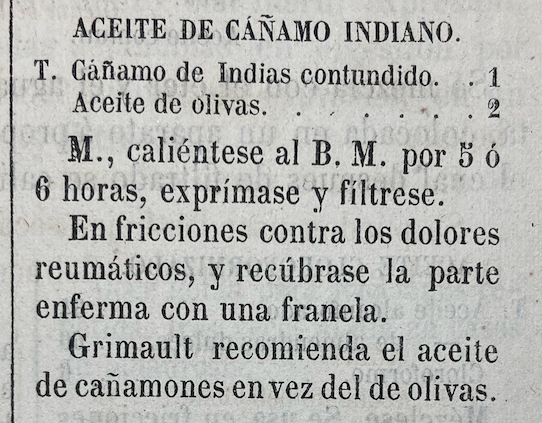
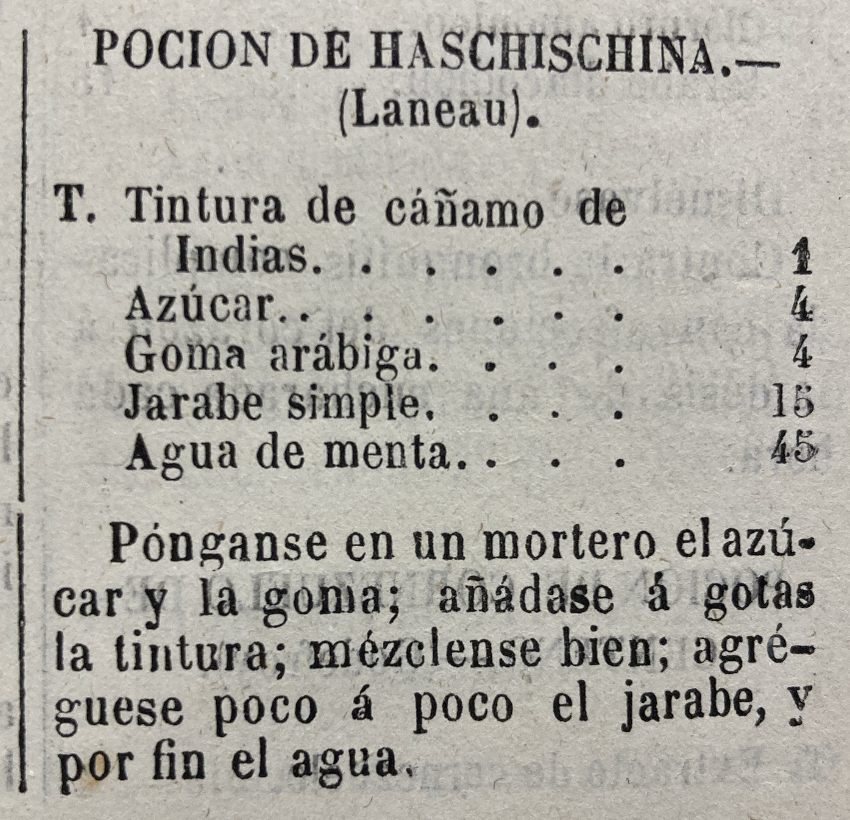
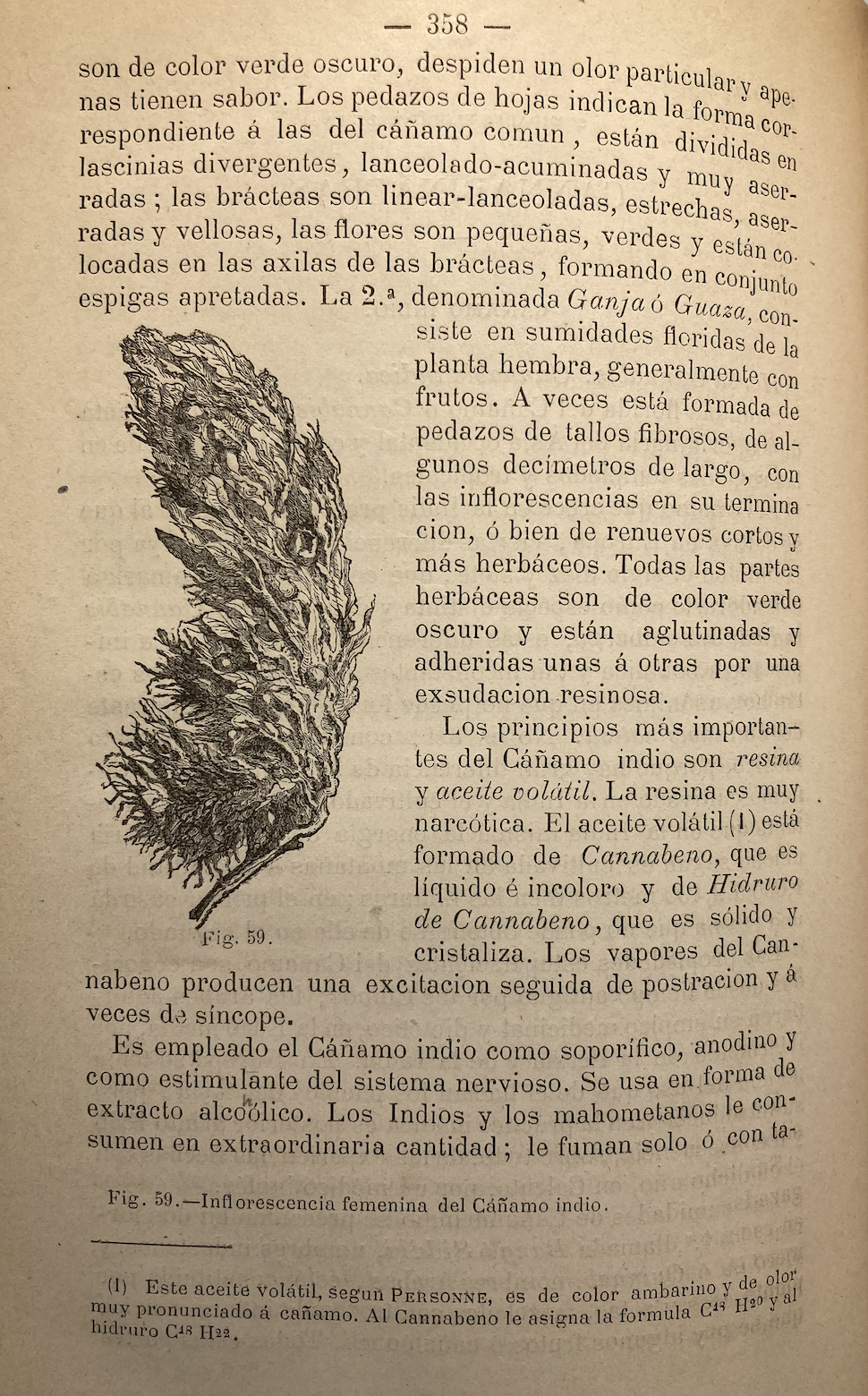
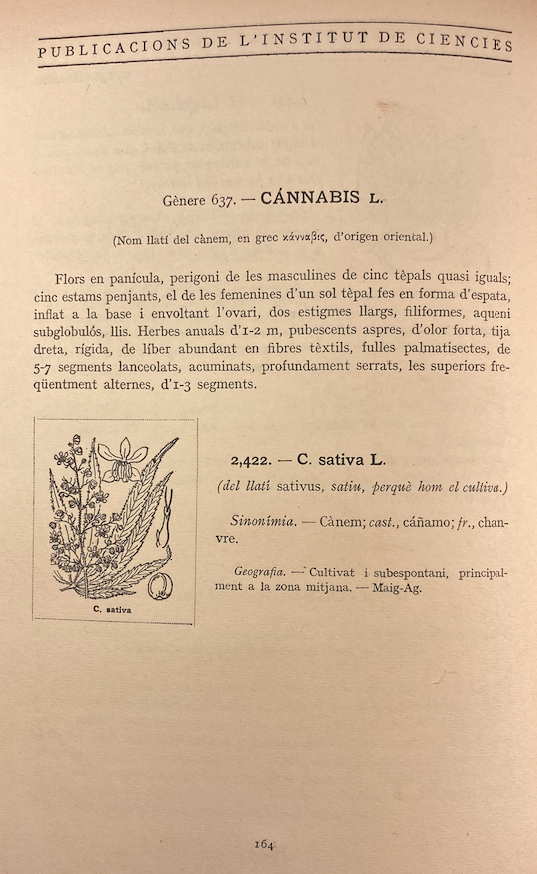
Figure 2. Excerpts from teaching materials used by Texidor (1875/77), Sánchez-Comendador (1879), and Font i Quer (1933). Sources: A: Texidor and Casasa 1875: 131; B: Texidor and Casasa 1877: 958 (Courtesy: UB, CRAI Lletres); C: Sánchez-Comendador (1879) (Courtesy: Arxiu Històric de la Ciutat de Barcelona); D: Cadevall & Font Quer (1933: 164) (Courtesy: Reial Acadèmia de Ciencies i Arts de Barcelona).
3.3.2. Disciplines of Omission — Organic Chemistry (Dα) and Galenical Pharmacy (Dβ)
Primary sources related to the contents of teachings in Dα («Química orgánica aplicada a la farmacia») and Dβ («Prácticas de operaciones farmacéuticas & Farmacia galénica») are even fewer than for Dγ and Dδ. And within them, the absence of hemp is striking.[35]
After Fors, Bassagaña and Rafael Sáez Palacios taught Dα for two years each, followed by Julian Casaña y Leonardo (1833–1911) for four decades until 1896. UB Rector for the last 20 years, Casaña was also notably the chairman of the 1888 Universal Exposition’s medical-pharmaceutical congress. His lessons could not be retrieved, but Casaña notably translated countless editions of influential, much-circulated and tradapted French formularies (Bouchardat, Dorvault’s L’Officine)[36] copiously referencing Cannabis formulations.
Baldomero Bonet Bonet (1857–1925) was originally assistant in Dδb (1886–1894/96?) before taking over Dα (1897–1900). His 1899 teachings (not mentioning hemp) are archived. Friend of Bonet, [Francisco] Agustín Murua i Valerdí (1874–1925) succeeded him in Barcelona, teaching Dα from 1902 until his passing. Unlike his predecessors, Murua was a Germanophile, passionate about recent advances in molecular chemistry. He received several public grants to study in Germany, including with Nobel-prize laureate Adolf von Baeyer.[37] Only one — very theoretical — volume of his teachings for 1902 remains, mentioning almost no plant. Passionate about the history of his discipline, Murua published an essay on the ancient Egyptian papyrus of Ebers for the RACAB, mentioning the «kind of haschisch» referred to therein.
Like Bonet, Casimir Brugués Escuder (1863–1940) began as Dδ2 assistant (1901–1933) moving to teach Dα for two years after Murua’s death. Very limited accounts from his teachings remain, but Brugués translated several textbooks (including with FP colleagues),[38] in particular Gilg’s manual (see below). In his «notes sobre la història del tabac» for RACAB, Brugués claimed in 1935 that hemp was already smoked in the region in Prehistoric times.[39] Cándido Torres González (1902–1995) replaced Brugués around 1927 (unclear dates). While there are more records of his teachings, none mention Cannabis. Torres also translated several textbooks, silent on hemp, but which were not part of the curriculum. A member of the far-right Falange party, Torres left Barcelona at the outbreak of the civil war;[40] like Palomas, it is unclear who replaced him.
* * *
Vicenç Munner y Valls (1824/8?–1876) taught Dβ («Prácticas de operaciones farmacéuticas» or «Farmacia galénica») after Balcells, from 1855 (or 1857) to 1874, alongside positions in other Faculties. There are no accounts from his teachings. He was followed by Bassagaña from 1874 to 1894 (see above), and Benito Torà y Ferrer (1833/35?–1910) until his death. Torà’s 1874 handbook Farmacia Práctica predated his professorship in Barcelona, addressing general methods without mentioning any materia medica. In 1913, Enrique Soler y Batlle (1877–1951) became lecturer in Dβ where he remained until 1950. A recognised physician and pharmacist, expert in pharmacopoeias, Soler was ambitious in character, managing to always remain close to power despite dramatically-changing political circumstances. He was twice FP Dean, and twice UB Rector during brief and tumultuous periods of transition (end of the first dictatorship in 1930, beginning of the second in 1939). In 1925, the government gave Soler diplomatic powers to represent Spain at the negotiations of the 2nd international pharmacopoeia conference in Brussels[41] (Pharmacopoeia Internationalis or P.I.)[42] which resulted in a standardisation treaty prompting a harmonisation of preparation methods for Cannabis galenicals (among others) in national pharmacopoeias. But Soler does not appear to have contributed to discussions on Cannabis in Brussels. There are two accounts from Soler’s classes, both in 1927 (notes and programme), which do not mention Cannabis, contrary to other comparable drugs. From Soler’s pen, only the handbook Medicamenta mentions hemp.
|
A.
|
B.
|
C.
|
D.
|
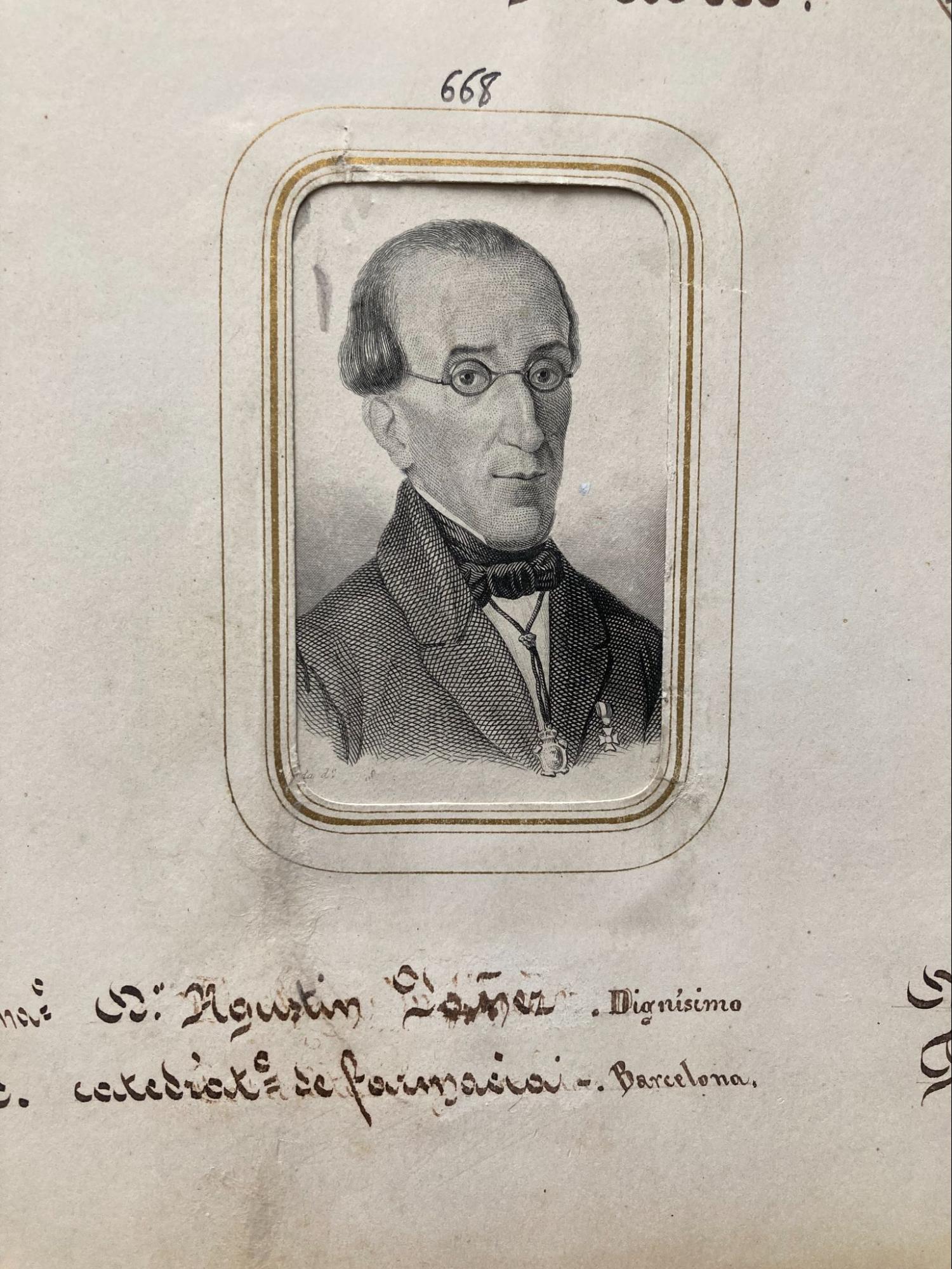
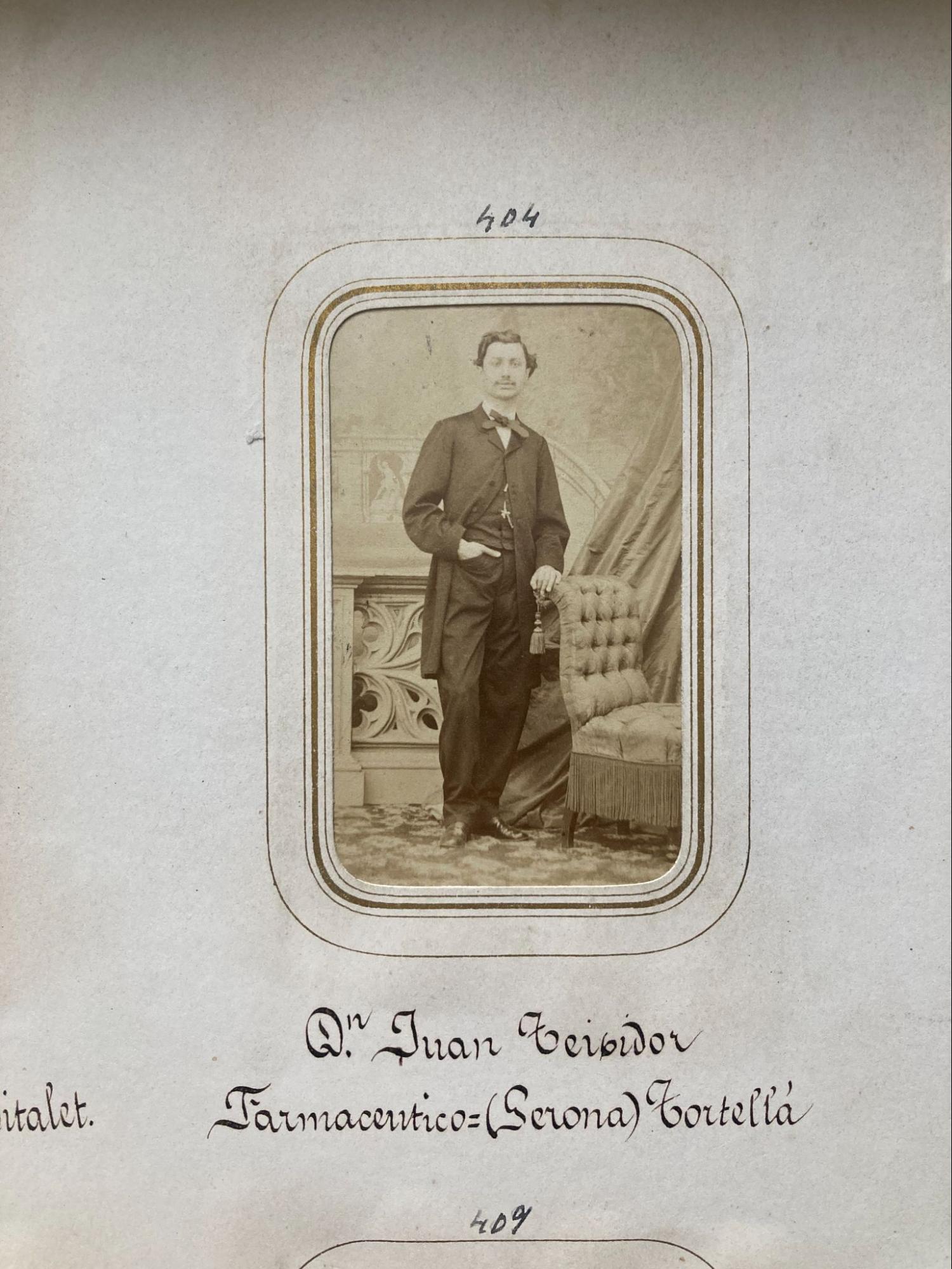
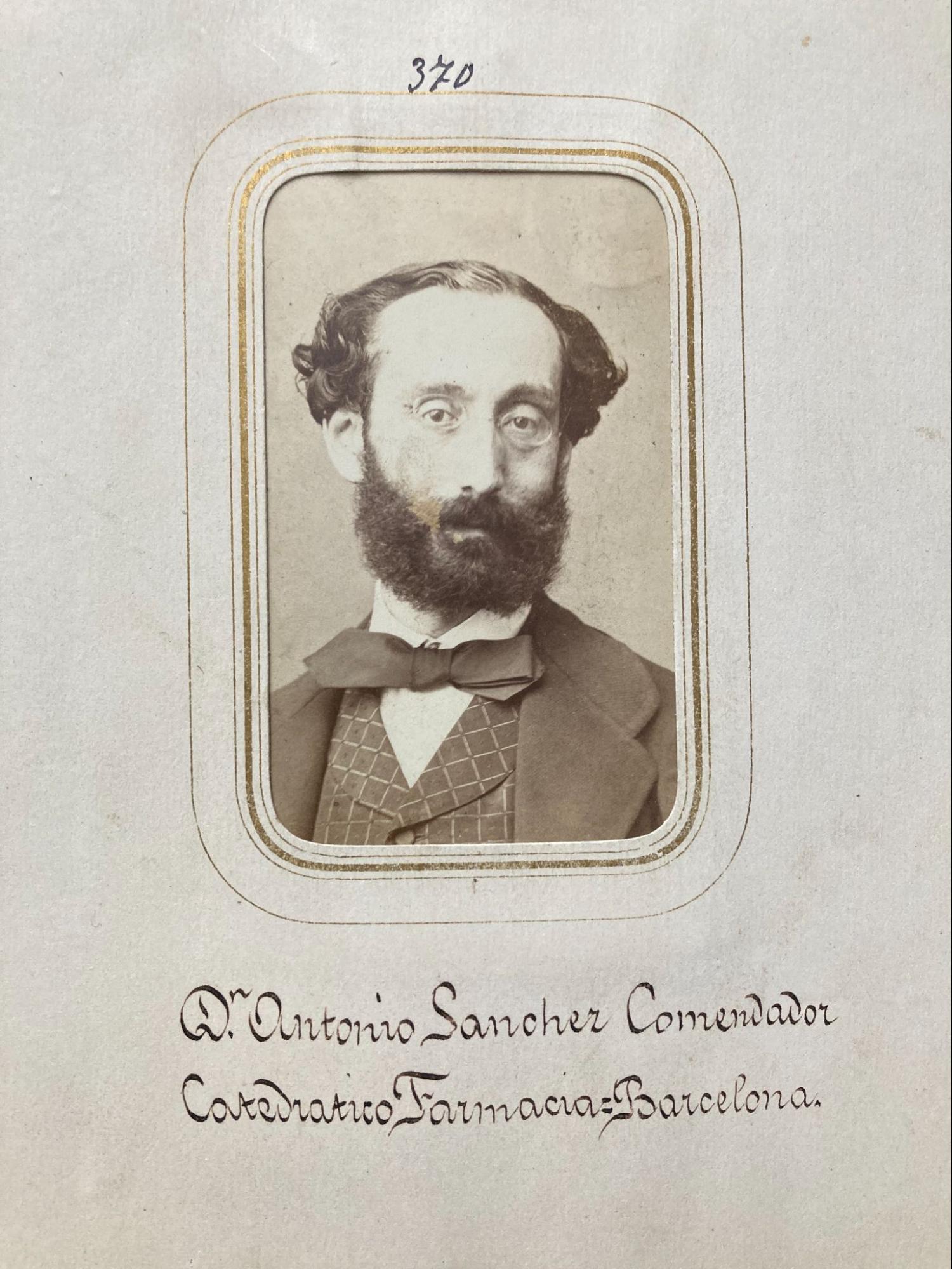
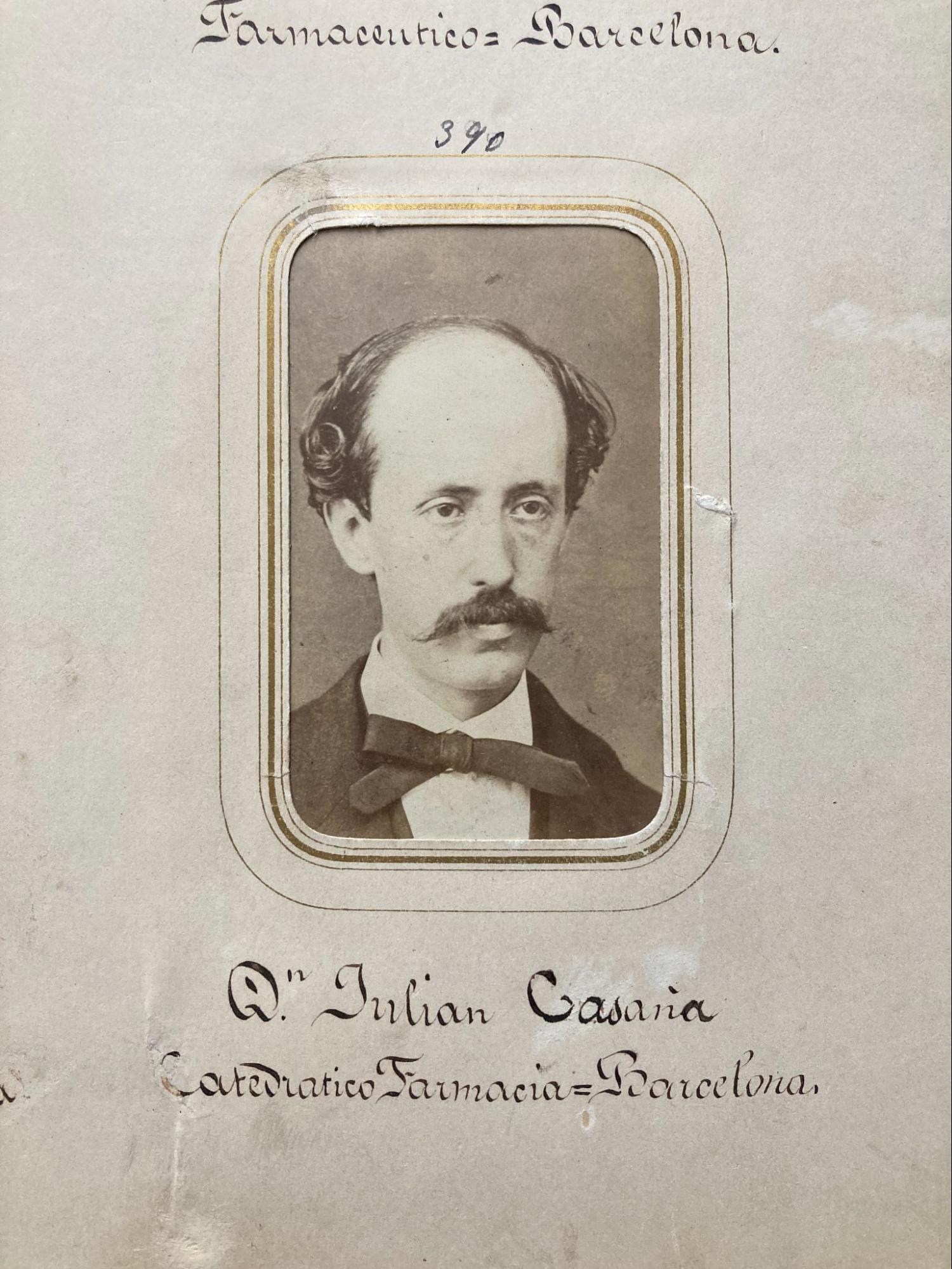
Figure 3. Portraits of Yáñez, Texidor, Sánchez-Comendador, and Casaña. Source: Pérez Mínguez M. Fotografías de los farmacéuticos de España [c. 1863]. RANF: MU, MA 330.
3.4. Imported Knowledge: Textbooks & Manuals
Complementary to course materials, programmes, notes, or accounts, FP textbooks and manuals contain useful additional context on the evolution and transmission of pharmaceutical knowledge around Cannabis. Textbooks were either directly relied upon in teachings, or facultative course materials present in the UB’s library collections at the time (in inventories) and sometimes still today. A majority mention Cannabis, often through copy, quotes, or tradaptations.
The 1838 Materia farmacutica by Manuel Jiménez Murillo [alt.: «Gimenez»] became an official Faculty textbook in 1845.[43] Strongly influenced by Germain Sée (later famous in Spain for his description of Cannabis extract as the «true sedative of the stomach» (15)) and other French authors, the manual’s section on the genus Cannabis is simple, mentioning that both «Semina cannabis [officinalis]» and the entire plant have a «strong smell that causes dizziness and fainting to those who breathe its emanations for long periods of time». Like for Fors’ manual (see above) Jimenez’s was still used in the 1870s (Quet’s teachings).
The room taken by foreign and translated textbooks was not negligible. As Cristina Riera Climent and Juan Riera Palomero have shown,[44] French-language authors (not only from France, but also Belgium: Figure 2B reproduces a «Laneau» (or «Lanneau») formula, famed in Spain, named after Joseph-François Lanneau (1818–1865), the chief pharmacist of Brussels hospital) constituted the main influences of the developing 19th century Spanish health sector. Quantitatively, French-language authors were followed at a fair distance by German and Italian ones with, much behind, British or American sources. As of 1858, the nationwide curriculum included two Spanish textbooks (Fors; Jimenez) for three French ones:[45] for Dα, Soubeiran’s Nouveau traité de pharmacie théorique et pratique (as we saw, already an inspiration for Fors), and Guibourt’s Histoire naturelle des drogues simples for Dγ, both discussing haschish and its similarities and differences with common French hemp. The third was Le Canu’s Cours complet de pharmacie, containing no mention of Cannabis.[46] The establishment of mandatory French language classes in the 1886 reformed curriculum may have reinforced (or simply enshrined) such cultural influence.
By 1934, the programme of the Faculty «recommended» students to read French authors and, only secondarily, «Germanic languages». UB’s historical library collections indeed reveal a slow shift of focus from France/Belgium towards Germany in the 20th century (perhaps facilitated by teachers like Murua?). The first German textbook in UB’s collections is Husemann’s Manual de materia médica y terapéutica in 1878, with «Indian hemp». In 1926, Brugués translated the 3rd edition of Lehrbuch der Pharmakognosie by Ernst Friedrich Gilg, which went on to be «not only used for lessons [Dγ] but also for pharmaceuticals to consult»[47] for over a decade. Palomas used it, and possibly Bruguñes and Cortés. It has three pages of detailed, high-quality descriptive information on hemp — both psychoactive parts and seed kernel — and on products actually available on the then-interconnected European market. Brugués and Font translated the 7th edition in 1934, with an updated text, shorter, but straightforward on monospecificity with a prose recalling Calahorra: «[L]a Cannabis sativa, única especie del género, es el cáñamo.»
From Italy, Milan’s pharmaceutical sector had some influence on the FP, through one handbook used in teachings for more than six decades: first translated in 1908 by Soler, Brugués, and Tayá, «Medicamenta» went on to be reissued, updated, corrected, and augmented (rather tradaptated) by Soler in 1921, 1926 (with many personal additions and his takeaways from the P.I. conference; reprinted five times until 1947), and 1951. Font took over for the 1954 edition, and a final 1962 revision with Regné de Otal. Medicamenta had by then acquired an entirely separate trajectory from its Milanese origins. Yet, despite thorough revisions (particularly 1940s, and in 1962 «a third-part [was] entirely new»), the simple but practical learning contents on Cannabis remained substantially unaltered 1921 through 1962: Hemp, the soft hydroalcoholic extract and tincture from its herb, the oil and emulsion from its fruits, and two «substances»: cannabine tannate and cannabinone (oleoresin).
4. Chronology and comparisons
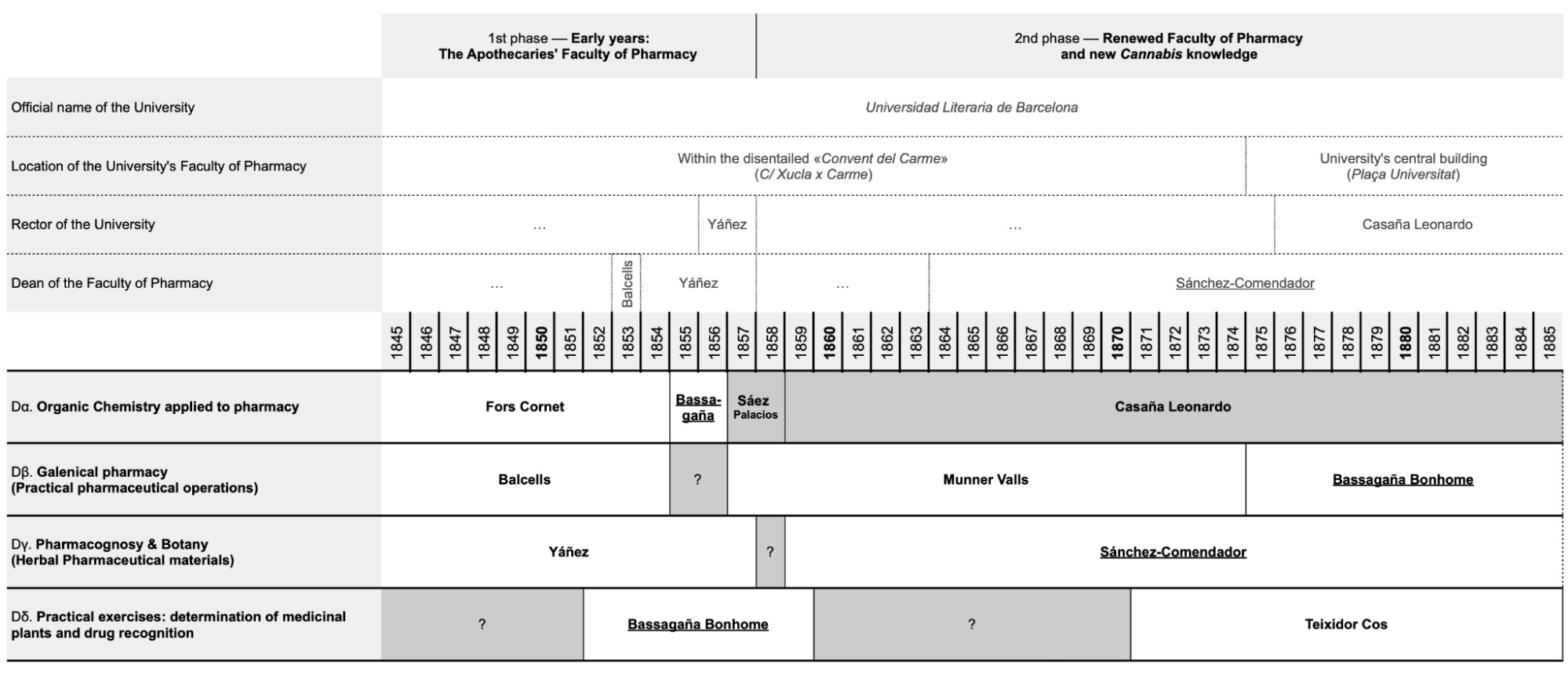
Five phases seem to emerge in Barcelona’s pharmacy teachings related to Cannabis (Figure 4):
- A first phase starts within the RCSV, continuing with the founding of the Faculty in 1845 in its early years until 1857 with the death of Yáñez and Balcells, followed shortly by Fors. Teachings (including their names) remained marked by an inertia of traditional approaches; Cannabis remained a fruit, and its galenicals were the oil and the emulsion, in spite of the arrival of new products, names, and knowledge of hemp in the port and streets of Barcelona.
- From there, the Faculty and its teachings slowly transitioned from apothecary to pharmacy — with the arrival of more substantial discussions of resin and psychoactivity associated with local and/or imported plants and products, with figures like Texidor or Sánchez-Comendador —, until the reform of studies in 1886…
- …associated with the «88 medical generation» and a peaking interest in hemp taxonomy and pharmaceutical handling epitomised by Calahorra de la Orden (but also at the FM, with insights on prescription patterns and mentions of «infusion» and «extract» as pharmaceutical forms), lasting two decades until around the turn of the century. (Bassagaña is the exception that proves the rule, teaching across all first three phases.)
- In the early 1900s and until 1923, an important renewal in the teaching staff occurred amidst relative stability inside the FP (contrasting with the troubled times outside), this period is marked by an apparent lesser interest in Cannabis at the FP (but apparently not at the FM) and no salient figure among the professorate. This phase also corresponds, with a five-year delay, to the period without Cannabis in the Official Spanish Pharmacopoeia: deleted from the 7th edition (1905), the 8th revision in 1930 reintroduced hemp with three monographs for «Cáñamo indiano P.I.», extract, and tincture.
- Cannabis returns in the last phase with teachers like Palomas or Font. Running from the 1923 coup d’état to the end of the civil war, the period is marked by an instability reaching inside the FP, ending in a disaggregated curriculum, with professors from all sides of the aisle either destituted, imprisoned, exiled, or assassinated.
A.
B.
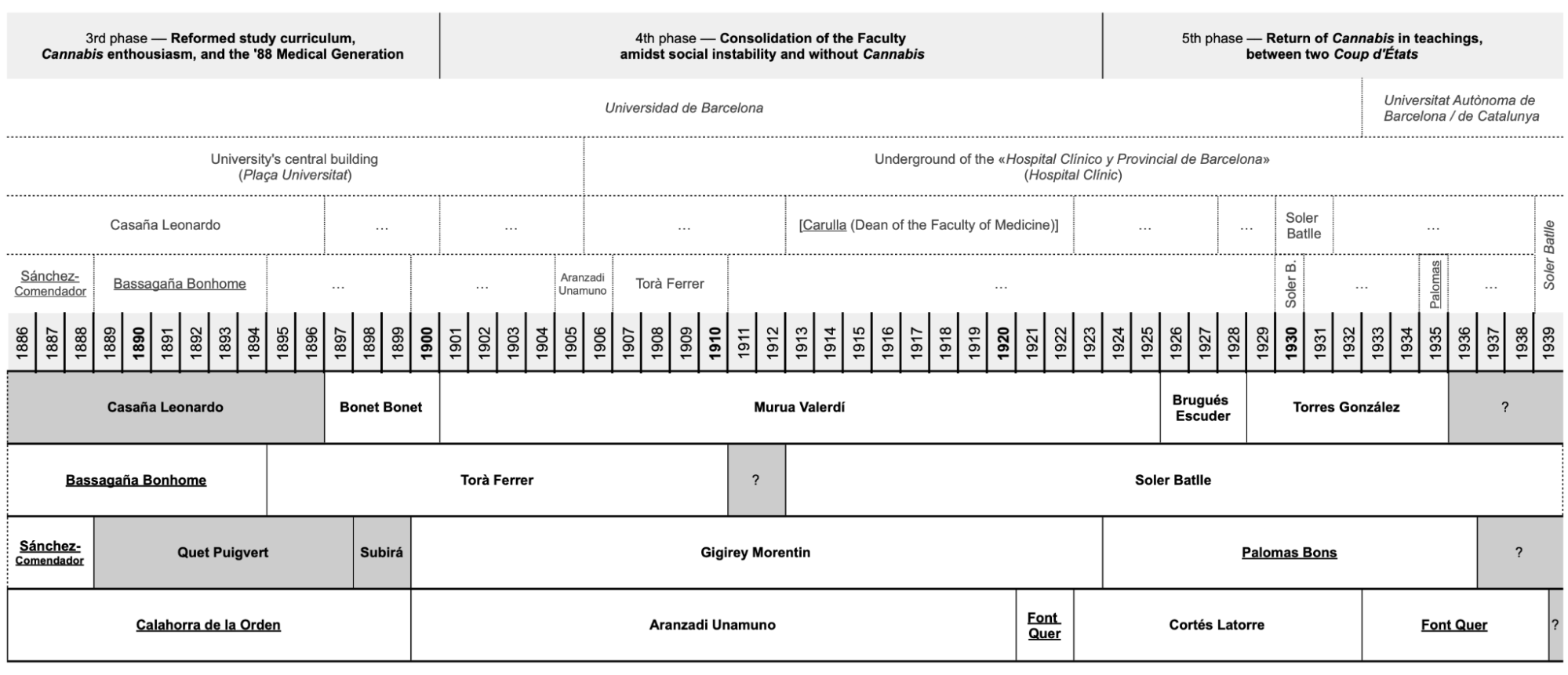
Figure 4. Tentative timeline of professors and institutional context in Cannabis-relevant disciplines (A: 1845–1885; B: 1886–1935). The upper panel (first four rows) indicate the institutional context (ellipses indicate positions held by individuals from other disciplines than the ones examined). Lower panel rows denote professorial appointments across the four disciplines addressing Cannabis instruction (grey shading: unavailable course materials; question marks: unidentified appointees; underlined names: professors with sustained scholarly interest in Cannabis).
Within this periodisation, the (partial) archival record reveals striking disciplinary asymmetries in Cannabis instruction. Botanists and pharmacognosists demonstrated sustained engagement, both in theoretical (Dγ) and practical (Dδ) classes — epitomised by the detailed monographs of Sánchez-Comendador, Calahorra, and Texidor, his determination keys for haschisch recognition, and the rich scientific contributions outside of the academia by Calahorra, Palomas, or Font i Quer — professors of organic chemistry (Dα) and galenical pharmacy (Dβ) largely omitted the plant from their teachings (but not from their side works). This absence is particularly notable in Dβ, where direct documentation lacks even a single explicit mention of hemp from Balcells to Soler (Bassagaña possibly excepted). This omission may be due to the relatively-simple, unspecific pharmaceutical operations required to obtain Cannabis extracts and tinctures (as for seed oils and emulsions), often using general methods. Regarding Dα, the highly uncertain chemistry of hemp certainly contributed to the absence from discussions: only cannabinol (CBN, which did not present the characteristic effects expected from medicinal Cannabis) was known after 1899, until cannabidiol (CBD) was identified in 1940, and the main active compound, dronabinol (delta-9-tetrahydrocannabinol), only in 1964.[48] Gigirey did not mention hemp in his 1924 treatise, but explained in the preamble that, amongst the large number of herbal drugs, he focused on those that were better-known from the organic chemistry standpoint. This suggests that chemical indeterminacy marginalised the plant within Dα teachings, perhaps affecting Dβ, and even the broader curriculum.
FP teachers’ engagement with Cannabis exhibited several asynchronicities with its apparent market presence. While Barcelona’s pharmacies advertised resin-rich hemp galenicals as early as 1835, with more-systematic presence after the 1860s,[49] the academic incorporation of this knowledge lagged substantially. Carbó’s «Haschisch, 1840 Europa» acknowledged this chronology, in 1882, while also noting that the use had by then «not generalised» — Calahorra blamed poor quality and adulteration in 1896 for hampering clinical development. Availability without use during phases 2 and 3? Difficult to say, provided the scarcity of sources, and the lack of prescription requirement for Cannabis medicines until 1916.[50] In Spain, this period (end of phase 4, and phase 5) marked a regulatory turning point for the formalisation of the entire pharmaceutical sector, which had struggled to industrialise — in the shadow of its neighbours — but whose industrial centre has crystallised in Barcelona.[51] But while regulations, restrictions, product registration, and other requirements over hemp medicines were steadily increasing, with «drug control» affecting hemp after 1928,[52] Barcelona’s Pharmacy professorate somewhat counter-intuitively reintroduced the plant in the curriculum.
Despite pronounced French influences, teachers in both Faculties of pharmacy and medicine rejected Lamarck’s two-species model with remarkable consistency — Texidor, notable exception —, insisting on monospecificity: whether called «cáñamo de Indias» or «indiano», «cànam indich», or «achiche», it differed in psychoactive potency only through climate and preparation, and was «not distinct from the Cannabis sativa of our country». Yet this theoretical recognition of local hemp’s potential did apparently not correlate with any practical exploitation, as pharmacists continued to learn to handle imported hashisch rather than locally-produced hemp resin (despite contemporaneous determinations of Spanish industrial hemp’s psychoactive properties).[53]
In spite of Lamarck, Barcelona’s Cannabis knowledge was overwhelmingly connected with French-language authors, a consistent source of inspiration and tradaptations for RCSV and 19th century FP teachers. German sources only timidly started to compete in the 20th century. While the Irish doctor O’Shaughnessy is often credited by historiographers for introducing medical cannabis to Europe, his influence on FP professors — like that of English-language sources generally — appears virtually absent. Sánchez-Comendador is the only source to briefly mention «un médico inglés» from Calcutta. This pattern supports the idea, already suggested elsewhere,[54] that the trajectory of «medical cannabis» in Barcelona and Spain differed than that of the more-documented British-American narrative.
4.1. Conclusions
This historical review of teaching sources from the UB reveals that Cannabis formed part of the scholarly knowledge transmitted to students between 1835 and 1939, in a constant negotiation between the slowly-evolving epistemological and experiential understandings of the plant, and the practical realities of market-available preparations.
Behind disciplinary asymmetries, the archival record demonstrates marked interest in the plant (particularly for disciplines pertaining to botany and pharmacognosy) and a strong inspiration from French, Belgian, and later German and Italian knowledge networks; the near-total absence of English language sources shows that Spanish pharmaceutical education treated Cannabis therapeutics along a trajectory distinct from the oft-told, simple narratives focused on British and US history.
Recovering this historical legacy — including figures whose contributions merit recognition, like Calahorra de la Orden — provides critical context and may inform efforts to (re)integrate Cannabis within the professional training of pharmacists, pursuant to the inclusion of a Cannabis flos monograph in the European Pharmacopoeia, and Spain’s Real Decreto 903/2025 recreating a framework for the compounding and dispensing of standardised magistral Cannabis preparations.
5. Notes
(I am sorry, the page numbers got lost in the change of format of the manuscript’s references at some point…)
[1] This article presents secondary findings derived from an archival research project undertaken between 2022 and 2025 (EUTC: European Union Traditional Cannabis medicines) with the . On the history of Cannabis cultivation on the Iberian peninsula, see Rull V et al., “Historical biogeography of Cannabis in the Iberian Peninsula: A probabilistic approach using palynological evidence,” PPEES 58 (2023): 125704, https://doi.org/10.1016/j.ppees.2022.125704
[2] Rodrígues Nozal R and González Bueno A, Entre el Arte y la Técnica: los orígenes de la fabricación industrial del medicamento (CSIC, 2005).
[3] Gozalbo Gimeno D, “El Archivo General Central (1858-1939): Aproximación a los fondos documentales desaparecidos,” in El Palacio Arzobispal de Alcalá de Henares: Historia y Arquitectura, ed. G Chamorro Merino (ARPA-Institución de Estudios Complutenses, 2014), 199–223.
[4] See in particular Gómez Caamaño JL, Páginas de Historia de la Farmacia (Iatros, 1995); Folch Andreu R, Elementos de Historia de la Farmacia, 2nd ed. (Viuda de G. Izquierdo, 1926); Jordi González R, Aportació a la història de la farmàcia catalana (1258-1997) (Fundació Uriach, 1998); Carmona Cornet AM, “Els professors regents agregats de la Facultat de Farmàcia de la Universitat de Barcelona,” 311–320, and “Primers ensenyaments i evolució de la ‘Farmàcia Pràctica’ a la Facultat de Farmàcia de la Universitat de Barcelona,” 327–332, in Proceedings of the 1st Simposi d’Historia de la Universitat de Barcelona (Barcelona, Spain, 1988); Gómez Caamaño JL, Historia del Real Colegio de Farmacia de San Victoriano (Dalmau Carles, 1958); Suñé Arbussà JM and Gaspar García MD, “Los primeros libros de texto utilizados en la Facultad de Farmacia de Barcelona,” Gimbernat 20 (1993): 187–198; Vallès Xirau J, “Sobre els estudis de botànica a la Facultat de Farmàcia de Barcelona i els seus antecedents immediats,” Butlletí Inst Catal Hist Nat 50 (Commemoratiu) (1985): 135–139; Roldan Guerrero R, Diccionario Biográfico y Bibliográfico de Autores Farmacéuticos Españoles, 4 vols. (IMPHOE, 1975 [vols. 1–2], 1977 [vol. 3]; Real Academia Nacional de Farmacia, 2003 [vol. 4]).
[5] Gómez Caamaño, Páginas de Historia.
[6] See Rull et al., “Historical biogeography of Cannabis”; Roig-Traver A, Algunos comentarios sobre el empleo terapéutico de los derivados del cannabis: una aproximación a la literatura médica española (1800-1939) (Universitat de València, Facultat de Medicina, 1996); Juan-Tresserras J, “La arqueología de las drogas en la Península Ibérica: Una síntesis de las recientes investigaciones arqueobotánicas,” Complutum 11 (2000): 261–274; Usó Arnal JC, “Cannabis en España: continuidades y puntos de inflexión históricos,” in Las sendas de la regulación del cannabis en España, ed. Regulación Responsable (Edicions Bellaterra, 2017), 33–44; Riboulet-Zemouli K and Allué Creus J, “Hemp Extract (Extractum Cannabis) in the Treatment of Gastrointestinal Distress and Dyspepsia: Historical Insights from Barcelona, Spain,” Pharmaceuticals 17, no. 12 (2024): 1585, https://doi.org/10.3390/ph17121585.
[7] Gómez Caamaño, Historia del Real Colegio.
[8] Gómez Caamaño, Páginas de Historia
[9] Universitat de Barcelona, Facultat de Medicina i Ciències de la Salut, “Get to know the Faculty: History,” monografía en internet (Universitat de Barcelona), https://www.ub.edu/portal/web/medicine-health-sciences/history
[10] Carmona Cornet, “Els professors regents agregats”; Vallès Xirau, “Sobre els estudis de botànica.”
[11] Roig-Traver, “Algunos comentarios”; Riboulet-Zemouli and Allué Creus, “Hemp Extract.”
[12] Garcia Espuche A, ed., Drogues, dolços i tabac: Barcelona 1700 (Ajuntament de Barcelona, 2010).
[13] Roig-Traver, “Algunos comentarios”; Riboulet-Zemouli and Allué Creus, “Hemp Extract.”
[14] Sánchez JM, “Medicina homœopática: venta de algunos medicamentos homœopáticos,” Bol Med Cirug Farm 2, no. 83 (1835): 545, https://hemerotecadigital.bne.es/hd/es/viewer?id=57f48bb3-c437-4b22-93d3-0dcec47b0275
[15] Carmona Cornet, “Els professors regents agregats”; Gómez Caamaño, Historia del Real Colegio.
[16] Folch Andreu, Elementos de Historia.
[17] Folch Andreu, Elementos de Historia.
[18] Gómez Caamaño, Páginas de Historia; Carmona Cornet, “Els professors regents”; Suñé Arbussà and Gaspar García, “Los primeros libros.”
[19] Burke P, “Cultures of translation in early modern Europe,” in Cultural Translation in Early Modern Europe, ed. P Burke and RP Hsia (Cambridge University Press, 2007), 7.
[20] Carmona Cornet, “Els professors regents agregats”; Gómez Caamaño, Historia del Real Colegio; Gómez Caamaño, Páginas de Historia.
[21] Rodrígues Nozal and González Bueno, Entre el Arte y la Técnica; Jordi González, Aportació a la història.
[22] Carmona Cornet, “Els professors regents agregats”; Roldan Guerrero, Diccionario Biográfico.
[23] Folch Andreu, Elementos de Historia; Roldan Guerrero, Diccionario Biográfico.
[24] Novellas Roig A, “El Canem Índich,” Universitat catalana: butlletí mensual, portaveu dels escolars catalans 3, nos. 21–22 (1902): 333–335 [AHCB: R 1900 4a].
[25] Palomas Bons X and Font Quer P, “Cultivo de plantas y su importancia en la economia nacional; y Discurso de constestación,” Memorias Real Acad Ciencias Artes Barcelona, 3.ª época, XXII (1930): 319–334, https://bibdigital.rjb.csic.es/records/item/15376-cultivos-de-plantas-y-su-importancia-en-la-economia-nacional?offset=1
[26] Broggi M, Carmona AM, Carmona MC, and Jorge D, “L’exili i el silenci dels farmacèutics catalans i de les institucions científiques de la IIa República espanyola,” Gimbernat 56 (2011): 97–122.
[27] Francés Causapé MC and González Bueno A, “Sobre el ‘Herbario Medicinal’ de Juan Texidor (1838-1885),” Acta Bot Malacitana 16 (1991): 470.
[28] Lamarck had described Cannabis sativa and Cannabis indica as two distinct species within the same genus Cannabis, contradicting the earlier model by Linné: a monospecific sativa (only one species, including the «Indian types»). Contemporary consensus sides with Linné, placing morphological differences at a much lower systematic level than species (chemovars); see McPartland JM and Guy GW, “Models of Cannabis taxonomy, cultural bias, and conflicts between scientific and vernacular names,” Bot Rev 83 (2017): 327, https://doi.org/10.1007/s12229-017-9187-0
[29] McPartland & Guy, ‘Models of Cannabis taxonomy’
[30] Camós Cabeceran A, La Huella de Lamarck en España en el Siglo XIX (CSIC, 2021).
[31] Navas Pérez T, “Esperiencias sobre el Haschischt, ó Esrar indígeno,” Farmacia Española 3, no. 39 (1871): 599–601, https://bibliotecavirtual.ranf.com/es/catalogo_imagenes/grupo.do?path=2005324
[32] Francés Causapé and González Bueno, “Sobre el ‘Herbario Medicinal.’”
[33] Rosell Armengol A and Blanco Castro E, “Font Quer: perfil biográfico y obra del autor de Dioscórides renovado,” Med Naturista 5, no. 1 (2011): 24–29; Puche C and Duro R, “Pius Font i Quer (1888–1964), the greatest Catalan botanist,” Contrib Sci 11 (2016): 121–124, https://doi.org/10.2436/20.7010.01.220
[34] Juan-Tresserras, “La arqueología de las drogas.”
[35] Although, evidently, the loss of some documentary records ought to be reminded.
[36] Roldan Guerrero, Diccionario Biográfico; Riera Climent C and Riera Palomero J, Libros, médicos y traductores en España (1850-1900) (Prensas Universitarias de Zaragoza, 2007).
[37] Roldan Guerrero, Diccionario Biográfico.
[38] Roldan Guerrero, Diccionario Biográfico.
[39] However, this is not supported by evidence. While cultivation on the Mediterranean Iberian coast dates back to ancient times (see Rull et al., “Historical biogeography of Cannabis”), Brugués’ claim is not backed by the archaeological record, where smoked remains appear only after the 10th century (Juan-Tresserras, “La arqueología de las drogas”), if not later.
[40] Roldan Guerrero, Diccionario Biográfico.
[41] Ramon Codina Länglin, another key Barcelona pharmacist, had been Spain’s delegate at the 1st conference, in 1902; Conférence internationale pour l’unification de la formule des médicaments héroïques, Bruxelles 1902: Procès-verbaux des séances tenues du 15 au 20 septembre 1902 (Imprimerie et Lithographie A. Lesigne, 1902), Archives de l’Académie royale de Belgique, Sous-sol Med. 0028 folio.
[42] Riboulet-Zemouli K, “1925–2025: a century of international pharmaceutical law,” J Pharm Policy Pract 18, no. 1 (2025), https://doi.org/10.1080/20523211.2025.2470840
[43] Suñé Arbussà and Gaspar García, “Los primeros libros de texto.”
[44] Riera Climent and Riera Palomero, Libros, médicos y traductores.
[45] Gómez Caamaño, Páginas de Historia.
[46] Other French-language publications were profuse in 19th century UB’s pharmacy and medicine library collections, including Soulier’s Traité de thérapeutique et de pharmacologie, the Littré medical dictionary, and the formularies of Bouchardat, Dorvault, and, in the 20th century, Dujardin-Beaumetz (the eight editions in UB library collections span 1889–1841). All with numerous hemp extract and fruit formulas. See Table 2.
[47] Roldan Guerrero, Diccionario Biográfico.
[48] Roig-Traver, Algunos comentarios; Usó Arnal, “Cannabis en España.”
[49] Roig-Traver, Algunos comentarios; Usó Arnal, “Cannabis en España”; Riboulet-Zemouli and Allué Creus, “Hemp Extract.”
[50] Riboulet-Zemouli and Allué Creus, “Hemp Extract.”
[51] Rodrígues Nozal and González Bueno, Entre el Arte y la Técnica; Gómez Caamaño, Páginas de Historia.
[52] Usó Arnal, “Cannabis en España”; Riboulet-Zemouli and Allué Creus, “Hemp Extract.”
[53] Navas Pérez, “Esperiencias sobre el Haschischt.”
[54] Usó Arnal, “Cannabis en España”; Riboulet-Zemouli & Allué Creus, “Hemp Extract”
[55] Lamarck had described Cannabis sativa and Cannabis indica as two distinct species within the same genus Cannabis, contradicting the earlier model by Linné: a monospecific Cannabis sativa (only one species sativa comprising all types, including the «Indian types»). Contemporary consensus sides with Linné, placing morphological differences at a much lower systematic level than species (chemovars) (15, 24).
[56] However, this is not supported by evidence. While cultivation on the Mediterranean Iberian coast dates back to ancient times (1), Brugués’ claim is not backed by the archaeological record, where smoked remains appear only after the 10th century (13), if not later.
[57] Other French-language publications were profuse in 19th century UB’s pharmacy and medicine library collections, including Soulier’s Traité de thérapeutique et de pharmacologie, the Littré medical dictionary, and the formularies of Bouchardat, Dorvault, and in the 20th century, Dujardin-Beaumetz (the eight editions in UB library collections span 1889–1841). All with numerous hemp extract and fruit formulas.
[58] Ramon Codina Länglin, another key Barcelona pharmacist, was Spain’s delegate at the 1st conference (1902).
6. Bibliography
Broggi, M., AM Carmona, MC Carmona, and D. Jorge. “L’exili i el silenci dels farmacèutics catalans i de les institucions científiques de la IIa República espanyola.” Gimbernat 56 (2011): 97–122.
Burke, Peter. “Cultures of translation in early modern Europe.” In Cultural Translation in Early Modern Europe, edited by Peter Burke and R. Po-chia Hsia. Cambridge University Press, 2007.
Camós Cabeceran, A. La Huella de Lamarck en España en el Siglo XIX. CSIC, 2021.
Carmona Cornet, AM. “Els professors regents agregats de la Facultat de Farmàcia de la Universitat de Barcelona.” 311–320. In Proceedings of the 1st Simposi d’Historia de la Universitat de Barcelona. Barcelona, Spain, 1988.
Carmona Cornet, AM. “Primers ensenyaments i evolució de la ‘Farmàcia Pràctica’ a la Facultat de Farmàcia de la Universitat de Barcelona.” 327–332. In Proceedings of the 1st Simposi d’Historia de la Universitat de Barcelona. Barcelona, Spain, 1988.
Conférence internationale pour l’unification de la formule des médicaments héroïques, Bruxelles 1902. Procès-verbaux des séances tenues du 15 au 20 septembre 1902. Imprimerie et Lithographie A. Lesigne, 1902. Archives de l’Académie royale de Belgique: Sous-sol Med. 0028 folio.
Folch Andreu, R. Elementos de Historia de la Farmacia. 2nd ed. Viuda de G. Izquierdo, 1926.
Francés Causapé, MC, and A. González Bueno. “Sobre el ‘Herbario Medicinal’ de Juan Texidor (1838-1885).” Acta Bot Malacitana 16 (1991): 470.
Garcia Espuche, A., ed. Drogues, dolços i tabac: Barcelona 1700. Ajuntament de Barcelona, 2010.
Gómez Caamaño, JL. Historia del Real Colegio de Farmacia de San Victoriano. Dalmau Carles, 1958.
Gómez Caamaño, JL. Páginas de Historia de la Farmacia. Iatros, 1995.
Gozalbo Gimeno, D. “El Archivo General Central (1858-1939): Aproximación a los fondos documentales desaparecidos.” In El Palacio Arzobispal de Alcalá de Henares: Historia y Arquitectura, edited by G. Chamorro Merino, 199–223. ARPA-Institución de Estudios Complutenses, 2014.
Jordi González, R. Aportació a la història de la farmàcia catalana (1258-1997). Fundació Uriach, 1998.
Juan-Tresserras, J. “La arqueología de las drogas en la Península Ibérica: Una síntesis de las recientes investigaciones arqueobotánicas.” Complutum 11 (2000): 261–274.
Lamarck, Jean-Baptiste. [Discussion of the distinction between Cannabis sativa and Cannabis indica is included in footnote 28; no separate publication details were supplied.]
McPartland, JM, and GW Guy. “Models of Cannabis taxonomy, cultural bias, and conflicts between scientific and vernacular names.” Bot Rev 83 (2017): 327. https://doi.org/10.1007/s12229-017-9187-0
Navas Pérez, T. “Esperiencias sobre el Haschischt, ó Esrar indígeno.” Farmacia Española 3, no. 39 (1871): 599–601. https://bibliotecavirtual.ranf.com/es/catalogo_imagenes/grupo.do?path=2005324
Novellas Roig, A. “El Canem Índich.” Universitat catalana: butlletí mensual, portaveu dels escolars catalans 3, nos. 21–22 (1902): 333–335. AHCB: R 1900 4a.
Palomas Bons, X, and P. Font Quer. “Cultivo de plantas y su importancia en la economia nacional; y Discurso de constestación.” Memorias Real Acad Ciencias Artes Barcelona, 3.ª época, XXII (1930): 319–334. https://bibdigital.rjb.csic.es/records/item/15376-cultivos-de-plantas-y-su-importancia-en-la-economia-nacional?offset=1
Puche, C, and R. Duro. “Pius Font i Quer (1888–1964), the greatest Catalan botanist.” Contrib Sci 11 (2016): 121–124. https://doi.org/10.2436/20.7010.01.220
Riboulet-Zemouli, K. “1925–2025: a century of international pharmaceutical law.” J Pharm Policy Pract 18, no. 1 (2025). https://doi.org/10.1080/20523211.2025.2470840
Riboulet-Zemouli, K, and J. Allué Creus. “Hemp Extract (Extractum Cannabis) in the Treatment of Gastrointestinal Distress and Dyspepsia: Historical Insights from Barcelona, Spain.” Pharmaceuticals 17, no. 12 (2024): 1585. https://doi.org/10.3390/ph17121585
Riera Climent, C, and J. Riera Palomero. Libros, médicos y traductores en España (1850-1900). Prensas Universitarias de Zaragoza, 2007.
Rodrígues Nozal, R, and A. González Bueno. Entre el Arte y la Técnica: los orígenes de la fabricación industrial del medicamento. Estudios sobre la ciencia 38. CSIC, 2005.
Roig-Traver, A. Algunos comentarios sobre el empleo terapéutico de los derivados del cannabis: una aproximación a la literatura médica española (1800-1939). Universitat de València, Facultat de Medicina, 1996.
Roldan Guerrero, R. Diccionario Biográfico y Bibliográfico de Autores Farmacéuticos Españoles. 4 vols. IMPHOE, 1975 (vols. 1–2), 1977 (vol. 3); Real Academia Nacional de Farmacia, 2003 (vol. 4).
Rosell Armengol, A, and E. Blanco Castro. “Font Quer: perfil biográfico y obra del autor de Dioscórides renovado.” Med Naturista 5, no. 1 (2011): 24–29.
Rull, V, F. Burjachs, JS Carrión, A. Ejarque, S. Fernández, JA López-Sáez, et al. “Historical biogeography of Cannabis in the Iberian Peninsula: A probabilistic approach using palynological evidence.” PPEES 58 (2023): 125704. https://doi.org/10.1016/j.ppees.2022.125704
Sánchez, JM. “Medicina homœopática: venta de algunos medicamentos homœopáticos.” Bol Med Cirug Farm 2, no. 83 (1835): 545. https://hemerotecadigital.bne.es/hd/es/viewer?id=57f48bb3-c437-4b22-93d3-0dcec47b0275
Suñé Arbussà, JM, and MD Gaspar García. “Los primeros libros de texto utilizados en la Facultad de Farmacia de Barcelona.” Gimbernat 20 (1993): 187–198.
Universitat de Barcelona, Facultat de Medicina i Ciències de la Salut. “Get to know the Faculty: History.” Monografía en internet. Universitat de Barcelona, consulted 28 Oct. 2025. https://www.ub.edu/portal/web/medicine-health-sciences/history
Usó Arnal, JC. “Cannabis en España: continuidades y puntos de inflexión históricos.” In Las sendas de la regulación del cannabis en España, edited by Regulación Responsable, 33–44. Edicions Bellaterra, 2017.
Vallès Xirau, J. “Sobre els estudis de botànica a la Facultat de Farmàcia de Barcelona i els seus antecedents immediats.” Butlletí Inst Catal Hist Nat 50 (Commemoratiu) (1985): 135–139.
Table 1: Archival repositories and collections consulted
|
Country |
City |
Archival fonds |
Acronym |
|
Spain (Barcelona region) |
Barcelona |
Arxiu Històric de la Ciutat de Barcelona |
AHCB |
|
Biblioteca de Catalunya |
BC |
||
|
Biblioteca Pública Arús |
BPA |
||
|
Reial Acadèmia de Ciències i Arts de Barcelona |
RACAB |
||
|
Reial Acadèmia de Medicina de Catalunya |
RAMC |
||
|
Universitat Pompeu Fabra |
UPF |
||
|
Barcelona (Universitat de Barcelona) |
Arxiu Històric i Patrimoni Documental (Edifici Central) |
UB-AHPD |
|
|
Arxiu Universitari del Hospital Clínic (CRAI Medicina) |
UB-Clínic |
||
|
Centre de Documentació de Biodiversitat Vegetal |
CeDocBiV |
||
|
CRAI Farmàcia i Ciències de l’Alimentació |
UB-Farma |
||
|
CRAI Fons Antics (Edifici Central) |
UB-FA |
||
|
CRAI Llatí (Edifici Central) |
UB-EC |
||
|
CRAI Lletres (Edifici Central) |
idem |
||
|
CRAI Lletres, Arxiu «Sala Ramon i Cajal» (Edifici Central) |
idem |
||
|
CRAI Física y Química, Fons Antic |
UB-FQFA |
||
|
Dipòsit Digital [online] |
Dipòsit Digital |
||
|
El Masnou |
Museu Cusí de la Reial Acadèmia de Farmàcia de Catalunya |
RAFC-Cusí |
|
|
Sant Cugat del Vallès |
Arxiu Nacional de Catalunya |
ANC |
|
|
Vilanova i la Geltrú |
Biblioteca–Museu Víctor Balaguer |
BMVB |
|
|
Spain (Madrid region) |
Alcalá de Henares |
Archivo General de la Administración |
AGA |
|
Madrid |
Archivo Histórico Nacional |
AHN |
|
|
Biblioteca Nacional de España |
BNE |
||
|
Real Academia Nacional de Farmacia |
RANF |
||
|
Universidad Complutense de Madrid |
UCM |
||
|
Belgium |
Brussels |
Archives de l’Académie royale des sciences, des lettres et des beaux-arts de Belgique–Trésors de l’Académie (Édifice Écuries) |
ARB |
|
France |
Paris |
Université de Paris-Cité, BIU-Santé Pharma |
BIU |
|
Conseil National de l’Ordre des Pharmaciens |
CNOP |
||
|
United Kingdom |
London |
Wellcome Library Collection |
WLC |
Table 2: Primary sources consulted
|
Author(s) |
Date |
Reference |
Fonds |
Localiser |
|
Various |
n/a |
Anuaris i memòries de la Universitat de Barcelona (1858 a 1977). [Yearbooks. Missing years: 1845–1858, 1860–1861, 1875–1876, 1876–1877, 1881–1882, 1891–1897, 1898–1901, 1903–1904, 1904–1905, 1916–1918, 1927–1934, 1935–1939] |
UB, Dipòsit Digital |
diposit.ub.edu/dspace/handle/2445/3521 |
|
Various |
1830 –1836 |
[Inventaris del Reial Col·legi de Farmàcia de Sant Victorià [1830–1836]. |
UB-AHPD |
02-2901:07 |
|
Juanich March, Francesc |
1836 |
Tratado elementar de materia médica externa. Barcelona: Joaquín Vergaduer. |
RACAB |
s/n |
|
Foy, F.; Foix y Gual, J. B. |
1838 (1835) |
Curso de materia médica ó de farmacologia traducido del que escribió en francés F. Foy ; refundido y arreglado por Juan Bautista Foix y Gual [2 vols.]. Barcelona: J. Verdaguer |
UB-Clínic |
R 615 FOY |
|
Hurtado de Mendoza, Manuel |
1840 |
Vocabulario Médico-Quirurgico ó Diccionario de Medicina y Cirugia …. Madrid: Boix. |
UB-Clínic |
R 61(038) HUR |
|
Fors y Cornet, Raimundo |
1841 |
Tratado de farmacia operatoria, ó sea farmacia èsperimental: Tomo I. Barcelona: Imprenta de Jose Taulò. |
Online |
books.google.es/books?id=aAx-nDZxssEC |
|
Fors y Cornet, Raimundo |
1841 |
Tratado de farmacia operatoria, ó sea farmacia èsperimental: Tomo II. Barcelona: Imprenta de Jose Taulò. |
Online |
books.google.es/books?id=L_SjkZZbbhkC |
|
Various (Balvey; Balcells) |
1847 |
[Dos expedientes: «Colegi de farmaceutichs de Barcelona»] |
ANC |
ANC1-541: UI.210 |
|
Balcells Camps, Josep Antoni |
1852 |
Universidad Literaria de Barcelona, Facultad de Farmacia. Año 5.º: Asignatura de práctica de las operaciones farmacéuticas y principios de análisis química; Programa arreglado por el profesor de dicha asignatura … para el curso 1852 á 1853. Barcelona: Imprenta de Narciso Ramirez. |
UB-EC (Lletres) |
FA-182/11 |
|
Yáñez y Girona, Agustí |
1852 |
Programa de las lecciones del segundo año de Farmacia. Barcelona: Universidad de Barcelona. |
UB-AHPD |
Facultat de Farmàcia: 5827-7 |
|
Foix y Gual, D. J. B. |
1855 |
Arte de recetar y Formulario práctico, conformes a las lecciones públicas dadas en la facultad de medicina de esta Universidad literaria de Barcelona. Barcelona: Imprenta del Porvenir. |
RAFC-Cusí |
AFC1130 |
|
Universidad Literaria de Barcelona |
1856 |
[Programes d’assignatures de Farmàcia, dels cursos: 1850/1851, 1851/1852, 1853/1854, 1854/1855 i 1855/1856] |
UB-AHPD |
Facultat de Farmàcia: 1874-4 |
|
Bassagaña Bonhome, Pere |
1859 |
Flora médico-farmacéutica abreviada : ó, sea descripción de las plantas medicinales, indígenas y exóticas mas usadas y algunas otras notables que no lo son, con indicación de su duración, del pais en que habitan, de la época en que florecen las que crecen en España, de sus usos farmacéuticos, sus virtudes médicinales, etc., etc.. Barcelona: Impr. de Narciso Ramírez. |
ANC |
ANC1-1200.BR.: 05.02.32.01.06 |
|
Texidor y Cos, Juan |
c. 1860 |
Herbario Sexual de Linneo. |
CeDocBiV |
DR2015-015: SB-A2-P3. [0701810062] |
|
Littré, E.; Robin, C. |
1865 |
Dictionnaire de Médecine, de Chirurgie, de Pharmacie, des Sciences Accessoires et de l’Art Vétérinaire. Douzième edition, entièrement refondue. Paris: J.B. Baillière et fils. |
UB-Clínic |
R 6(038) DIC |
|
Texidor y Cos, Juan |
c. 1866 |
Herbario Agrícola, ó colección de las plantas que mas se citan en los tratados de agricultura. Herbario Medicinal. Tomo I (Talamifloras y Calicifloras). Olot: Imprenta y librería de Juan Bonet. |
CeDocBiV |
DR2015-015: SB-A2-P2. |
|
Anonymous |
c. 1870 |
[Apuntes manuscritos anónimos sobre terapéutica (s.n./s.d.) de la Facultad de Farmacia de Barcelona]. |
UB-Clínic |
[in: R 615 CAR] |
|
Carbó de Aloy, Narciso |
1870 |
Apuntes de terapéutica, farmacología y arte de recetar en el curso de 1868 á 1869 [fascículos I & II]. Gràcia: Cayetano Campins. |
UB-Clínic |
R 615 CAR |
|
Quet Puigvert, Esteban |
1871 |
Fitología médica ó Estudio de plantas medicinales, indígenas y exóticas, de sus partes, productos y principios, en toda la estensión que pueda convenir a los profesores de ciencias médicas. Santiago: Estab. Tip. de José M. Paredes. |
UB-Farma |
Reserva: R 615.322 QUE |
|
Texidor y Cos, Juan |
1871 |
Flora farmacéutica de España y Portugal, precedida de varios capítulos preliminares y determinación de materiales farmacéuticos exóticos. Madrid: Imp. JM Ducazcal. |
BNE |
1/25496 |
|
Munner Valls, Vicenç |
1873 |
Extracto de las lecciones explicadas por el Dr. Vicente Munner y Valls en la cátedra de análisis químico con aplicación a las ciencias médicas instalada por la Excma. Diputacion de Barcelona; Segunda edición. Barcelona: Establ. tip. de Jaime Jepús. |
RACAB |
s/n |
|
Calahorra de la Orden, Enrique |
1875 |
«Hachisch ó Cañamo indio: estudio químico y farmacéutico», La Farmacia Española, 7(43):682-683. |
RANF |
Hemeroteca R/1_1: Año VII (1875) No. 43 |
|
Calahorra de la Orden, Enrique |
1875 |
«Hachisch (continuación)», La Farmacia Española, 7(44):700-702. |
RANF |
Hemeroteca R/1_1: Año VII (1875) No. 44 |
|
Texidor y Cos, Juan; Casasa y Xarrié, Antonio |
1875 /1877 |
Farmacopea general, alopática, veterinaria y homeopática. Barcelona: Imprenta de Oliveres / Xumetra y Miquel. (2 vols.) |
UB-EC (Ramon i Cajal) |
Dipòsit: Cer-7917 |
|
Husemann, Theodore Gottfried |
1878 |
Manual de materia médica y terapéutica : escrita para estudiantes y prácticos con comentarios a la Farmacopea germánica … Segunda edición española corregida y aumentada por el autor, vertida al castellano y anotada por José Camó y Montobbio. Madrid: Carlos Bailly-Baillière. |
RAMC |
s/n |
|
Sánchez Comendador y Pagniucci, Antonio |
1879 /1880 |
Tratado elemental de farmacofitologia. Barcelona: Impr. de Jaime Jepús. |
BC |
R 615.32 San (t. 1); 03 Dipòsit General: 61-8-1542 (t. 2) |
|
Bouchardat, A.; Casaña Leonardo, Julián |
1880 |
Novísimo formulario magistral por A. Bouchardat, traducido y aumentado con más de 700 fórmulas nuevas españolas y extranjeras (18ª edición). Madrid: Carlos Bailly-Baillière. |
RAFC–Cusí |
AFC1232 |
|
Bouchut, E.; Després, A. |
1880 |
Diccionario de Medicina y de Terapéutica Médica y Quirúrgica … traducido de la tercera edición francesa y aumentado por D. Pedro Espina y Martínez y D. Antonio Espina y Capo. Madrid: Cárlos Bailly-Baillière. |
UB-Clínic |
R 61(038) BOU |
|
Gimeno Cabañas, Amalio |
1881 |
Tratado elemental de terapéutica, materia medica y arte de recetar. València: Pascual Aguilar; pp. 907-909 |
RAMC |
1107 |
|
Campà y Porta, Francisco de Paula |
1881 |
Lecciones de Ginecopatía o enfermedades especiales de la mujer, profesadas en la Facultad de Medicina de Valencia; Recogidas telegráficamente por D. Enrique Almar. València: José M. Blesa |
RAMC |
440Bis |
|
Carbó de Aloy, Narciso |
1882 |
Programa de terapéutica y farmacología redactado y seguido en el curso de 1882 á 1883 …. Barcelona: José Miret. |
RAMC |
s/n |
|
Universidad de Barcelona |
1886 –1900 |
[Plans d’estudi de 1886 i la seva reforma 1900. 1886–1900] |
UB-AHPD |
Facultat de Farmàcia: 3337-3 |
|
Bouchardat, A.; Casaña Leonardo, Julián |
1888 |
Novísimo formulario magistral por A. Bouchardat, traducido y aumentado con más de 700 fórmulas nuevas españolas y extranjeras (26ª edición). Madrid: Carlos Bailly-Baillière. |
RAFC-Cusí |
AFC1235 |
|
Calahorra de la Orden, Enrique |
1889 |
Programa-resúmen de unas lecciones de botánica descriptiva farmacéutica. Barcelona: Impr. Ibérica de Francisco Fossas. |
UB-Farma |
Reserva. |
|
de Letamendi, Josep |
1889 |
Curso de patología general basada en el principio individualista ó unitario. Madrid: E. Cuesta / J. Giráldez. |
UB-Clínic |
R 616 LET |
|
Calahorra de la Orden, Enrique |
1892 |
Programa de botánica descriptiva y determinación de plantas medicinales. Barcelona: Tipografia española 1892. |
BMVB |
Fons general: FP/931 |
|
Universidad de Barcelona |
1893 |
[Quadres de professors, assignatures, dies i hores. – 1891 – 1893] |
UB-AHPD |
Facultat de Farmàcia: 5830-17 |
|
Valentí Vivó, Ignacio |
1893 |
Antropología experimental : programa de medicina legal y toxicología : curso de 1894 á 1895. Barcelona: Jaime Jepús. |
UB-Clínic |
R F/VAL |
|
Peset y Cervera, Vicente |
1894 |
Curso elemental de terapéutica, materia médica y arte de recetar, con nociones de hidrología médica, para uso de los alumnos de tercer año. Valencia: Federico Domenech. |
UB-Clínic |
R 615 PES |
|
Calahorra de la Orden, Enrique |
c. 1895 |
Universidad de Barcelona: Apuntes de botánica general y descriptiva; tomados de las explicaciones dadas por el catedrático Dr. D. Enrique Calahorra [Botanica; Facultad de Farmacia, Curso de 1895 á 1896]. Barcelona: Libreria de Lance de Antonio Rosés. |
BPA |
E 7-7-28 |
|
Torá y Ferrer, Benito |
1897 |
Farmacia Práctica. Barcelona: Libreria de Lance de Antonio Rosés. |
RAFC-Cusí |
AFC1275 |
|
Bonet Bonet, Baldomero |
1899 |
Elementos de química orgánica : aplicada á la farmacia. Barcelona: Impr. de Pedro Ortega. |
UB-FQFA |
547 BON |
|
Aranzadi Unamuno, Telesforo |
1900 |
Programa de un curso de botánica descriptiva. Barcelona: Imprenta de Francisco J. Altés y Alabart. |
AHCB |
Biblio. B 1900 8º op. 1 |
|
Valentí Vivó, Ignacio |
1900 |
Programa de medicina legal y toxicología curso de 1900 á 1901. Barcelona: Henrich y cª. |
UB-Clínic |
R F/VAL |
|
Bonet Bonet, Baldomero |
1901 |
Laboratorio de química orgánica : relación de trabajos prácticos ejecutados por los alumnos durante el curso de 1899 a 1900 / bajo la dirección de Baldomero Bonet y Agustín Murua. Madrid: Universidad Central, Facultad de Farmacia. |
RACAB |
Shelf |
|
Bonet Bonet, Baldomero |
1902 |
Laboratorio de química orgánica : relación de trabajos prácticos ejecutados en este laboratorio durante el curso académico de 1900 a 1901 / bajo la dirección de Baldomero Bonet y Agustín Murua. Madrid: Universidad Central, Facultad de Farmacia. |
RACAB |
Shelf |
|
[Ministère de l’Agriculture du Royaume de Belgique] |
1902 |
Conférence internationale pour l’unification de la formule des médicaments héroïques, Bruxelles 1902. Brussels: Imprimerie et Litographie A. Lesigne |
ARB |
Sous-sol: Med 0028 folio |
|
Murúa Valerdi, Agustín |
1903 |
Curso de química Orgánica, aplicada a la farmacia; explicado en la Universidad de Barcelona …. 1.ª parte (ilustrada con grabados); Introducción a la Química Orgánica: 1902 á 1903. Barcelona: Imprenta de Pedro Ortega. |
RACAB |
s/n |
|
Littré, E.; Gilbert, A. |
1905 |
Dictionnaire de Médecine, de Chirurgie, de Pharmacie, des Sciences qui s’y rapportent. Vingt et unième édition, entièrement refondue. Paris: J.B. Baillière et fils. |
UB-Clínic |
R 61(038) LIT |
|
Peset y Cervera, Vicente |
1905 /1906 |
Terapéutica : materia médica y arte de recetar con hidrología médica. Segunda edición. Valencia: Francisco Vives Mora. |
UB-Clínic |
R 615 PES |
|
Ministerio de Estado [España] |
1906 |
Arreglo internacional para la unificación de la fórmula de los medicamentos heroicos. [Copias – Arreglo de 1902, acta de la conferencia de firma en 29/11/1906] |
AHN |
Mª_EXTERIORES_TR,340 (Negociación 76) |
|
Murúa Valerdi, Agustín |
1906 |
Un curso de Química Orgánica Experimental del Profesor Adolfo V. Bayer dado en la Universidad de Munich durante el semestre de verano de 1905. Barcelona: F. Badia. |
RACAB |
s/n |
|
Aranzadi Unamuno, Telesforo |
1907 |
Memorandum de botánica descriptiva aplicada a la farmacia (con 170 figuras). Barcelona: Imprenta de Francisco J. Altés Alabart. |
AHCB |
Biblio. B 1907 8º op. 2 |
|
Carulla Margenat, Valentín; Serés, Manuel |
1908 |
Apuntes de terapéutica tomadas taquigráficamente de las explicaciones dadas por el catedrático Dr. D. Valentín Carulla; Curso 1908–1909. Barcelona : Talleres Gráficos. |
UPF |
s/n |
|
Murúa Valerdi, Agustín |
1910 |
«La Química y la Farmacia entre los Egipcios», Memorias de la Real Academia de Ciencias y Artes de Barcelona, 8(10): 151–202. |
RACAB |
s/n |
|
Murúa Valerdi, Agustín |
1912 |
Compendio de Historia de la Química y de la Farmacia. Madrid: Imp. y Enc. de E. Raso. |
RACAB |
s/n |
|
Murúa Valerdi, Agustín |
1912 |
«Nota bibliográfica histórica acerca de las más notables farmacopeas», Memorias de la Real Academia de Ciencias y Artes de Barcelona, 3.ª Epoca, Tomo X (n.º 15). Barcelona: Sobrinos de López Robert y C.ª, impresores. |
RACAB |
Memòries i treballs: t. X, 135.8 (CF.59) |
|
Associació General de Metges de Llengua Catalana |
1918 |
Bibliografia medical de Catalunya: inventari primer, prés dels llibres antics i moderns presentats en l’Exposició Bibliográfica anexa al Segon Congrés de Metges de Llengua Catalana celebrat a Barcelona del 24 al 28 de juny de 1917. Barcelona: Elzeviriana. |
BC |
Bon. 5-III-22 |
|
Carulla Margenat, Valentín; Vanrell, J.; Pérez, J. |
1918 |
Apuntes de terapéutica; tomados de las explicaciones dadas por el catedrático Valentín Carulla; por los alumnos J. Vanrell, Jesús Pérez. Barcelona: Librería médica de J.B. Aragonés. |
UB-Clínic |
R 615 CAR |
|
Carulla Margenat, Valentín; et al. (alumnos) |
1914 |
Apuntes de terapéutica : curso 1913-14 tomados de las explicaciones dadas por el catedrático Dr. D.Valentín Carulla, corregidos y aumentados (Curso 1913-14). Barcelona: Juan Bautista Aragonés. |
UB-Clínic |
R 615 CAR |
|
Ebstein, W. (ed.) |
1914 |
Tratado de Medicina Clínica y Terapéutica (traducido … por … José Góngora y Tuñón y José Coll y Bofill), Segunda edición. Barcelona: José Espasa é Hijos. |
UB-Clínic |
R 616 TRA |
|
Albiol Mateu, Jacinto |
1919 |
Manual del practicante de farmacia : guía y formulario. Tortosa: Casa Editorial Monclús / Impr. Querol. |
UB-EC (Ramon i Cajal) |
Dipòsit: Cer-9793 |
|
Font Quer, Pius |
1920 |
Programa de un curso de botánica descriptiva. Barcelona: Impr. de Francisco Altés. |
RACAB |
s/n |
|
Soler y Battle, Enrique; Roger-Suriá, Miguel S.; Rossell y Vilà, Pere M. |
1921 |
Medicamenta: Guía teorico-práctica para Farmacéuticos, Médicos y Veterinarios (Segunda edición revisada y considerablemente aumentada). Barcelona: Editorial Labor, S.A. |
UB-Farma |
s/n |
|
Gigirey Morentín, Luís |
1924 |
Tratado de los productos vegetales de uso más frecuente en farmacia. Barcelona: Bosch. |
UB-Farma |
Reserva: R 615.32 Gig |
|
Legación del Reino de España en Bruselas |
1925 |
[Various 1925] |
AGA |
(10)113_54/15626 |
|
Rosenberg, Hugo; Soler y Battle, Enrique |
1925 |
Pharmacompendium: Guía-resúmen de las más importantes Farmacopeas oficiales. Traducido del alemán y considerablemente aumentado. Barcelona: Editorial Labor. |
UB-Farma |
s/n |
|
Cortés Latorre, Cayetano |
1926 |
Universidad de Barcelona, Facultad de Farmacia; Lecciones de botánica descriptiva: Fanerogamia. Barcelona: Libreria Bosch. |
ANC |
ANC1-160.BR.: 02.08.12.05.01 |
|
Gilg, Ernst Friedrich; Brandt, Willem |
1926 |
Farmacognosia: materia farmacéutica vegetal y animal…; traducción de la tercera edición alemana por Casimiro Brugués. Barcelona: Editorial Labor, S.A. |
ANC |
ANC1-160.BR.: 02.08.12. |
|
Soler y Battle, Enrique |
1927 |
Programa de la asignatura de Farmacia Práctica y Legislación Relativa a la Farmacia. Barcelona: Imprenta Elzeveriana y Librería Camí, S.A. |
UB-Farma |
R C/39 |
|
Soler y Battle, Enrique |
1927 |
Apuntes de farmacia pràctica. Barcelona: Librería Castells. |
UB-Farma |
R 615.014 Sol |
|
Torres y González, Cándido |
1927 |
Universidad de Barcelona, Facultad de Farmacia: Programa de química orgánica aplicada a la farmacia. Barcelona: Imprenta Enzeveriana y Librería Camí, S.A. |
UB-EC (Lletres) |
FA-133/45 |
|
Dietrich, Eugenio |
1928 |
Nuevo Recetario de Farmacia. Colección de fórmulas y procedimientos empleados en Farmacia, Química, Droguería y profesiones afines (versión de la 14ª edición alemana revisada por el Dr. Guillermo Kerkhof). Barcelona: Gustavo Gili, Editor. |
UB-Farma |
s/n |
|
Torres y González, Cándido |
1928 |
Universidad de Barcelona, Facultad de Farmacia: Curso de química orgánica farmacéutica; II. Serie cíclica. Barcelona: Lit. e Impr. de Joaquín Mora. |
UB-Farma |
R 547 Tor |
|
Torres y González, Cándido |
1930 |
Cuaderno de laboratorio de química orgánica : síntesis y análisis de medicamentos : primer curso. Barcelona: Facultad de Farmacia. |
UB-Farma |
R 547 Tor |
|
Palomas Bons, Xavier |
1931 |
Materia farmacéutica vegetal : programa de un Curso de la Facultad de Farmacia. Barcelona: UB |
ANC |
ANC1-160.BR.: 02.08.12.05.02 |
|
Cadevall Diars, Joan; Font Quer, Pius |
1933 |
Flora de Catalunya: Enumeració y descripció de les plantes vasculars espontànies que fins avui hi ha conegudes i de les més importants que s’hi cultiven; Volúm V. Barcelona: Institut d’Estudis Catalans, Secció de Ciències. |
RACAB |
s/n |
|
Gilg, Ernst; Schürhoff, P. N. |
1934 |
Botánica aplicada a la farmacia, segunda edición (traducción de la 7ª edición alemana, por Font Quer, P. and Brugués, C.). Madrid: Editorial Labor. |
RANF |
B: XIII-3-31 – No. 2455 |
|
Universitat Autònoma de Barcelona, Facultat de Farmàcia |
1934 |
[Plans d’estudis de la Facultat de Farmàcia + Pruebas de Exámenes] |
UB-AHPD |
Universitat Autònoma: 2730-4 |
|
Palomas Bons, Xavier |
1935 |
Un comentari a la VIII edició de la «Farmacopea Oficial Española», comunicación presentada a la sessió científica del día 30 d’abril de 1934. Barcelona: Impremta Badia. |
RAFC-Cusí |
n/a |
|
Brugués Escuder, Casimiro |
1935 |
«Algunes notes sobre la història del tabac», Memorias de la Real Academia de Ciencias y Artes de Barcelona, 3.ª Epoca, Tomo XXV, pp. 61–84. Barcelona: Sobrinos de López Robert y C.ª, impresores. |
RACAB |
Memòries i treballs: t. XXV, 148.2 |
|
Karrer, Paul |
1937 |
Tratado de química orgánica; Traducido de la 4.ª edición alemana por Cándido Torres. Barcelona: Marín. |
ANC |
ANC1-160.BR.: 02.08.12. |
|
Universitat Autònoma de Barcelona, Facultat de Farmàcia |
1937 |
[Facultat de Farmàcia: Règim escolar – 1933 – 1937] |
UB-AHPD |
Universitat Autònoma: 2682-2 |
|
Hager; Frerichs, G.; Arends, G.; Zörnig, H. |
1942 |
Tratado de Farmacia Práctica, para farmacúticos, droguistas, médicos y funcionarios de sanidad (Traducción de la tercera edición alemana) [revisión del 1937] Publicado bajo la dirección de Enrique Soler y Batlle. Barcelona, Madrid, etc.: Editorial Labor, S.A. |
RAFC-Cusí |
s/n |
|
Soler y Battle, Enrique |
1951 |
Medicamenta: Guía teorico-práctica para Farmacéuticos y Médicos (Cuarta edición). Barcelona: Editorial Labor, S.A. |
UB-Farma |
R 615(09) Sol |
|
Font i Quer, Pius |
1962 |
Medicamenta: Guía teorico-práctica para Farmacéuticos y Médicos (Sexta edición). Barcelona: Editorial Labor, S.A. |
UB-Farma |
s/n |